



Beyond the Certificate: Why Powder-Bed Additive Manufacturing Requires a New Era of Process Evidence

By Industrial Manufacturing Editorial Desk
In the fast-evolving landscape of industrial additive manufacturing (AM), a familiar routine plays out on the shop floor every day: a batch of metal or polymer powder arrives accompanied by a neat certificate of analysis. Operators log the lot number into a database, cross-reference it against previous successful runs, and load it into the machine. Because the equipment has produced acceptable parts before, a dangerous temptation sets in—the assumption that the powder is fundamentally "under control."
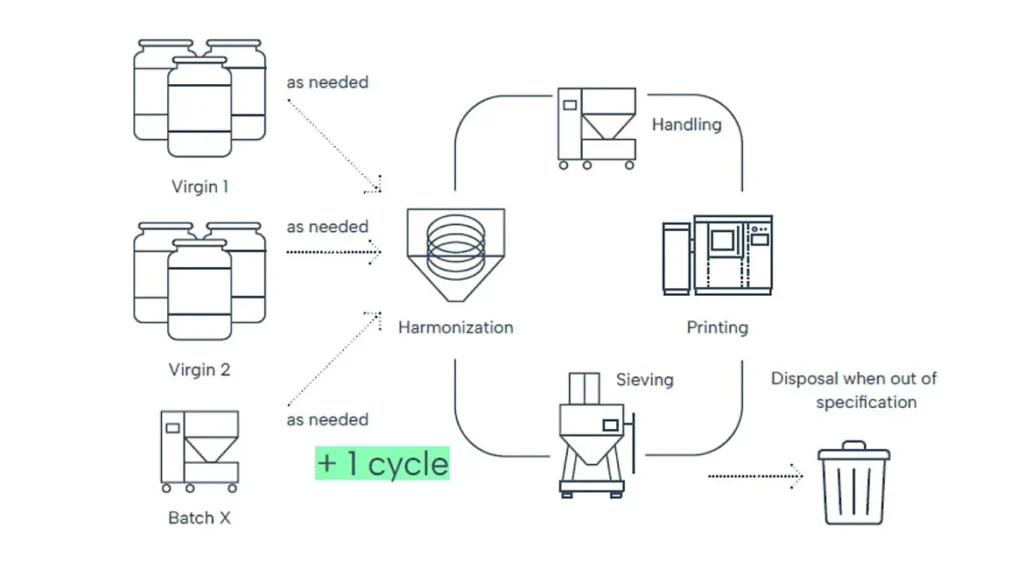
According to industry quality experts, this shortcut is not only flawed; it is a major vulnerability. In production-grade powder-bed fusion, raw material inputs are dynamic entities that change incrementally with every physical interaction. Whether it is handled, exposed to ambient air, sieved, refreshed, mixed, or stored, the powder evolves. Because these changes are typically gradual, they frequently escape notice, bypassing obvious build failures. Instead, they manifest as subtle, insidious issues: increased scatter in mechanical properties, elevated porosity, erratic build-to-build variation, or scrap rates that spike without pointing an obvious finger back at the raw material.
By the time engineers suspect the powder, root cause analysis teams are often already deep down expensive rabbit holes, scrutinizing machine calibration, laser parameters, operator techniques, or post-processing results. This disconnect highlights a systemic flaw in many AM operations: powder history is still routinely treated as passive background documentation rather than active, queryable quality evidence. For regulated sectors and high-reliability production environments, that paradigm is no longer sustainable.
Main Facts: The Hidden Vulnerability of AM Raw Materials
At its core, industrial additive manufacturing relies on a continuous material lifecycle that resists static documentation. Unlike traditional subtractive manufacturing, where raw stock properties are largely homogenous and stable, powder-bed AM involves extensive material recycling.
The primary facts defining the modern AM powder challenge include:

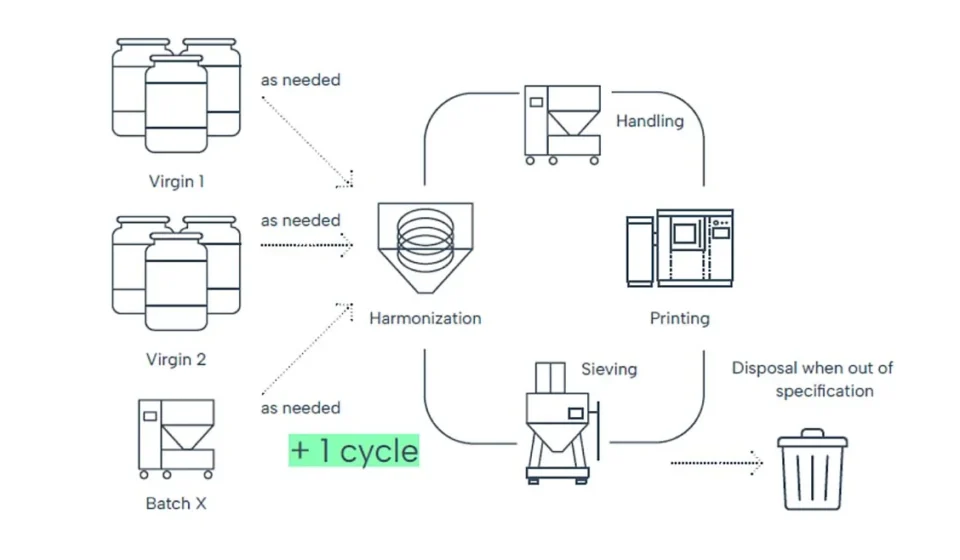
- The Dynamic Material Lifecycle: Powder changes continuously through delivery, storage, filling, sieving, mixing, and printing.
- The Blind Spot of Traditional Tracking: Static lot numbers and certificates of analysis capture only the beginning of a powder’s life, missing the compounding effects of reuse, blending, and environmental exposure.
- Misallocated Troubleshooting: When quality defects occur, engineering teams frequently misdirect resources toward machine parameters rather than evaluating cumulative powder degradation.
- The Regulatory Shift: Customers and regulatory bodies increasingly demand end-to-end traceability, requiring proof that the process behind every part is controlled, explainable, and backed by verifiable data.
Chronology: The Evolution of Powder Management in AM
To understand how the industry arrived at its current quality bottleneck, it is helpful to examine the historical progression of material handling in additive manufacturing.
Phase I: The Prototyping Era (Manual Logging and Tribal Knowledge)
In the early days of 3D printing, AM was primarily a prototyping tool. Material management was rudimentary. Operators relied on paper logs, simple spreadsheets, and tribal knowledge. Powder reuse was unrestricted, and quality control was judged almost entirely by whether a part emerged from the build chamber intact and met basic visual inspections.
Phase II: The Compliance Transition (Static Batch Tracking)
As AM transitioned into low-volume production, industries such as aerospace, medical devices, and automotive manufacturing demanded greater accountability. This led to the adoption of batch tracking. Manufacturers began storing certificates of analysis digitally, recording lot numbers against specific build jobs, and establishing rigid, arbitrary cycle limits (e.g., allowing powder to be reused a maximum of five times before disposal). While this introduced a baseline of organization, it remained a blunt instrument that often discarded perfectly good powder while missing subtle degradation in heavily mixed batches.
Phase III: The Modern Imperative (Condition-Based Digital Control)
Today, the industry is entering a third phase driven by strict regulatory requirements and the economic necessity of scaling production. Leading manufacturers are moving away from blunt cycle limits and isolated spreadsheets toward integrated, condition-based control strategies. By identifying Critical-to-Quality (CTQ) parameters—such as oxygen content, particle size distribution (PSD), and morphology—and connecting them directly to final part performance via advanced software, organizations are transforming powder management from a shop-floor chore into an active, data-driven risk management strategy.
Supporting Data: Strategies, Reuse, and the Shift to Condition-Based Control
Navigating powder reuse is fundamentally an economic balancing act complicated by quality risks. Powder is expensive; conservative, single-use disposal strategies generate prohibitive costs and environmental waste, while excessive physical characterization slows down production workflows.
To manage this balance, industrial operations typically deploy one of three primary reuse methodologies:

- Single-Use Virgin Powder: Offers the simplest control narrative and maximum material consistency, but incurs exceptionally high costs and material waste.
- Fixed Refresh Ratio: Maintains predictable material behavior by combining virgin powder and reused powder in a constant, predetermined ratio for every build. This approach succeeds only if overflow, virgin input, and top-up pathways are rigorously tracked.
- Batch Methods and Blending Strategies: Balances traceability with high material utilization. While strict batch methods restrict refreshing to a single virgin lot, advanced blending strategies allow multiple virgin batches to be integrated. However, these complex methods require robust digital oversight to prevent uncontrollable degradation.
| Reuse Strategy | Cost Impact | Traceability Complexity | Risk Profile | Best Suited For |
|---|---|---|---|---|
| Single-Use Virgin | High | Low | Low | Critical flight-hardware, medical implants |
| Fixed Refresh Ratio | Moderate | Medium | Moderate | Serial production with stable geometries |
| Batch / Blending | Low | High | High-to-Moderate | High-volume industrial applications requiring optimization |
Moving beyond these structural strategies requires a transition from cycle limits to condition-based control. Rather than discarding powder based solely on how many times it has been through a printer, advanced facilities monitor specific CTQs. These metrics must be tailored to the specific material, machine architecture, and end-use application. When combined with Statistical Process Control (SPC), organizations can identify material drift before it manifests as scrap, rework, or catastrophic mechanical failure.
Official Responses and Industry Perspectives
Industry stakeholders, software developers, and quality engineers are increasingly vocal about the necessity of overhauling how powder data is managed.
"Batch tracking is a sensible first step, but real AM production does not stay that clean," notes quality engineering literature from AM process optimization firms like amsight. "If the answer to what happened to a powder batch sits across spreadsheets, PDFs, shared folders, and operator notebooks, the evidence chain is fragile. Stored somewhere is not the same as audit-ready, and traceable is not the same as queryable."
Regulatory auditors echo these concerns. In quality-critical sectors, inspectors are no longer satisfied with retrospective reconstruction exercises during an audit. They expect an unbroken digital thread that links raw material input parameters directly to non-destructive testing (NDT) results, microstructural analysis, and final acceptance records.
"Many powder problems are not pure process science problems," industry analysts emphasize. "They are handling problems, documentation problems, traceability problems, or data-connection problems. Quality systems need to reflect that reality by integrating powder data into the core manufacturing execution system (MES) rather than treating it as a peripheral note."
Implications: What "Good" Looks Like in Regulated AM
The evolution of powder management carries profound implications for the commercial viability and technological maturity of additive manufacturing. As companies scale their AM operations, the cost of poor material visibility multiplies.

Achieving a truly mature, audit-ready AM operation requires the harmonization of three core pillars:
- Governance: Establishing a documented, standardized powder management strategy that aligns seamlessly with international standards, customer-specific requirements, and internal quality thresholds.
- Operations: Implementing rigorous shop-floor workflows, training qualified personnel, defining clear CTQs, and maintaining the operational discipline required to correlate powder conditions with part outcomes.
- Infrastructure: Deploying physical and digital architectures that ensure clear material segregation, controlled storage environments, contamination mitigation, and unified software platforms.
When an organization successfully transitions from manual record-keeping to digital powder lifecycle management, the benefits extend far beyond compliance. By eliminating disconnected spreadsheets and manual evidence assembly, manufacturers can significantly reduce audit preparation times, optimize their powder refresh routines, minimize unnecessary characterization testing, and accelerate root-cause analysis when anomalies do occur.
The Maturity Self-Assessment
Every AM organization must critically evaluate its current operational maturity by asking fundamental questions:
- Are powder movements still handled manually with only a basic inventory overview?
- Are batches and reuse counts recorded, yet completely disconnected from individual build files?
- Are powder measurements captured, only to languish in disconnected spreadsheets?
- Or are powder properties continuously monitored, statistically trended, and directly linked to final part outcomes?
For many manufacturing teams, the illusion of digitalization persists simply because they measure parameters like oxygen content or particle size distribution. However, if those critical data points remain isolated from the broader manufacturing ecosystem, the operation remains vulnerable where it matters most.
Conclusion
Additive manufacturing has spent the past several decades proving its capability to fabricate highly complex, high-performance geometries that were once thought impossible. The defining challenge of the current decade is entirely different: proving that the industry can control the underlying variables of these processes consistently, economically, and with verifiable evidence that customers and regulators can implicitly trust.
Raw material powder is one of the most critical variables in the entire additive manufacturing value chain. Treating it with the analytical rigor, digital infrastructure, and governance it demands is no longer optional—it is the price of admission for the future of industrial production.