



Bridging the Gap: How Monumental is Using Robotics to Solve the Global Construction Crisis

The construction industry is facing a demographic cliff that threatens the global economy. With 92% of contractors struggling to fill critical roles and a staggering 4.5 million home deficit in the United States alone, the traditional methods of building are no longer sufficient to meet the demand. As the skilled labor pool shrinks due to an aging workforce and a waning interest among younger generations to enter the trades, the industry has reached an inflection point.
Monumental, an innovative construction technology firm, is stepping into this breach. Rather than positioning itself as a disruptor looking to replace human labor, the company views robotics as an essential survival tool for an industry in decline. By deploying a specialized fleet of robots to handle the physically taxing and increasingly scarce labor of bricklaying, Monumental is providing a blueprint for the future of building.
The Macro Crisis: Why Construction is Ripe for Robotics
The narrative surrounding artificial intelligence and robotics is often dominated by fears of job displacement. However, in the construction sector, the reality is the polar opposite. As Salar al Khafaji, founder and CEO of Monumental, points out, this is one of the few industries where the primary challenge is not efficiency—it is sheer survival.
"Construction is a really interesting use case for robots and AI, because it’s one of the few industries where the narrative is really not AI and robots coming in to replace labor to make things cheaper or redundant," al Khafaji told The Robot Report. "It’s literally there’s not enough people to do the work. We desperately need this technology."
The statistics provided by the Association of General Contractors underscore this sentiment. The industry is losing veterans to retirement at an accelerating rate, and the pipeline of new apprentices is not keeping pace. In Western Europe, particularly in the U.K., Germany, and the Netherlands, bricklaying has consistently ranked as the number one job-shortage category. For developers, the lack of bodies on the ground translates to project delays, ballooning budgets, and a failure to address the critical housing supply gap.
Chronology of a Robotic Fleet: From Concept to Site
Monumental’s approach to building a robotic fleet was calculated and iterative. Recognizing that the construction process is highly complex, they chose to focus on the "shell" of a building—a phase that requires immense physical effort and precision.
Phase 1: The Foundation of Strategy
Before deploying their first robot, the company analyzed the three distinct stages of home construction:
- Ground Preparation: Moving earth and preparing the site.
- Shell Construction: The vertical building process, including brick and block work.
- Finishing: Interior work, such as flooring, drywall, and electrical.
Monumental identified the shell phase as the "sweet spot" for robotics. While ground preparation has seen significant investment—with companies like Bedrock Robotics, Gravis Robotics, and TerraFirma securing massive funding rounds—the shell phase has remained relatively underserved. By focusing on the structural bones of a building, Monumental has carved out a unique niche in a fragmented market.
Phase 2: The Pisa, Petra, and Panama Deployment
The company’s star performer is "Pisa," a non-humanoid robot designed specifically for bricklaying. Pisa utilizes two specialized tower crane arms: one to pick and place bricks with high precision, and the other to extrude mortar.
However, a bricklayer is only as effective as their material supply. To address this, Monumental developed two additional units:
- Petra: Responsible for the continuous supply of bricks to the site.
- Panama: Responsible for the precision delivery of mortar.
These robots are not merely single-purpose tools; they are part of a modular platform. According to al Khafaji, only 10% of the company’s R&D effort is focused on the mechanics of bricklaying itself. The remaining 90% is dedicated to the general challenges of operating autonomous machinery on a chaotic, ever-changing construction site—such as connectivity, navigation, and coordination. To solve the connectivity challenge, the team utilizes "Pathion," a proprietary device that provides 4G, 5G, Starlink, and Wi-Fi coverage to ensure the fleet remains synchronized.
Supporting Data: Why Material Handling is the Key
One of the most profound realizations Monumental encountered during its field trials was that the biggest time-sink in construction is not the specialized work itself, but the movement of materials.
"A lot of things in construction actually are about material handling," al Khafaji noted. "If you go observe construction workers, you see them with wheelbarrows moving around material all the time. Solving material handling is really important on a construction site."
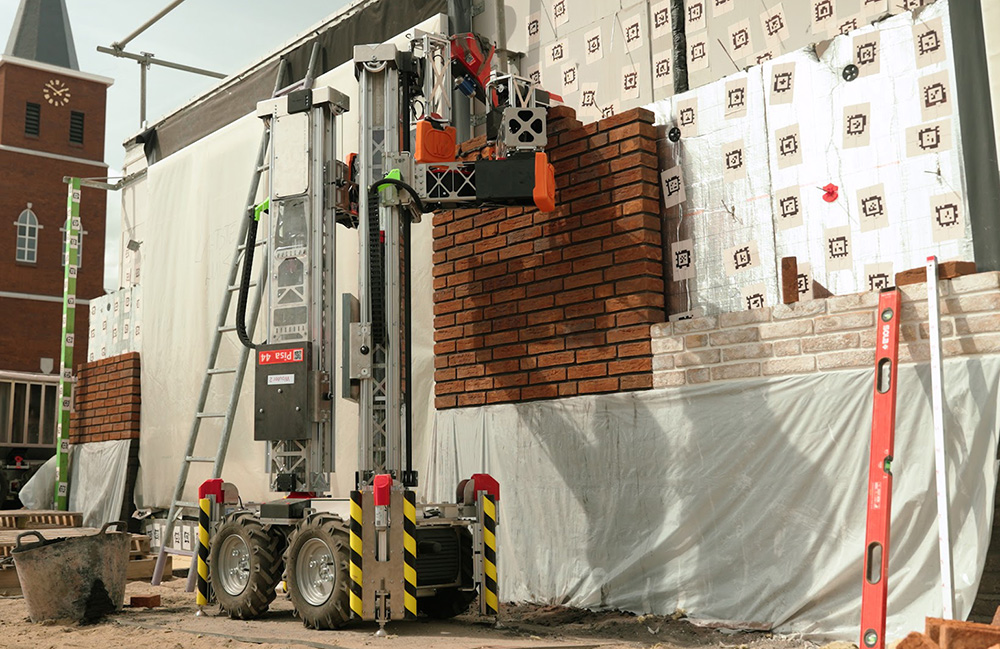
By automating the flow of supplies, Monumental is effectively increasing the "uptime" of its bricklaying robot. This logistical efficiency is the secret to their success. By treating the construction site as a data-driven environment, they can achieve a level of consistency that manual labor struggles to maintain over long, grueling shifts.
Navigating the Fragmented Construction Ecosystem
The construction industry is notoriously fragmented, often involving a dozen or more subcontractors on a single job site. Many tech companies struggle to break into this space because they attempt to force their way into the rigid, vertically integrated workflows of larger corporate clients.
Monumental’s genius lies in its flexibility. They do not attempt to change the construction company’s entire workflow; they simply arrive as a subcontractor.
"No one is vertically integrated," says al Khafaji. "If I need foundations to be poured, or plumbing to be done, I’m just going to call up this company, and they’re going to send a couple of dudes, and they’re just going to do the thing. That’s how they operate. No one expects that subcontractor to follow their playbook."
By positioning themselves as a "robotic subcontractor," Monumental avoids the friction of enterprise-level integration. They show up, perform their specific task, and move on. However, this model comes with the inherent risk of the "dependency chain." As al Khafaji candidly admits, even the most sophisticated robot cannot lay bricks if the supplier fails to deliver them on time. The success of the technology is ultimately tethered to the reliability of the human-managed supply chain.
Lessons from the Field: Edge Cases and Real-World Data
The transition from a robotics lab to a construction site is where theory meets the messy, unpredictable reality of the built environment. Monumental has prioritized "live" deployments over prolonged lab testing, believing that the only way to scale is to learn from real-world failures.
A primary example of this learning process occurred during an early deployment involving black bricks. The company’s computer vision systems had been trained on standard red bricks and lighter-colored materials. When the crew arrived on-site to find the building design called for pitch-black bricks, the robots struggled with identification.
"We got new data," al Khafaji said. "This is actually why it’s great to do these deployments. You get real-world data."
This iterative process—gathering data on weather patterns, brick variations, regional building regulations, and site-specific hazards—is what will allow the technology to transition from small, controlled pilots to widespread, industrial-scale deployment.
Implications for the Future of Housing
The work being done by Monumental represents a potential turning point for the housing crisis. If the company can successfully scale its fleet, the cost and time associated with building the shell of a home could drop significantly, while the safety of the site increases.
While some competitors, like Reframe Systems, are taking a "robotic microfactory" approach to build entire homes off-site, Monumental’s strategy of on-site, modular robotics seems better suited for the existing, fragmented nature of the construction industry.
As the industry continues to lose its workforce, the "Robot as a Subcontractor" model may prove to be the most viable path forward. The goal is not to eliminate the human element, but to offload the most dangerous and repetitive tasks to machines, allowing the remaining skilled workforce to focus on project management, oversight, and complex craftsmanship.
Ultimately, Monumental is not just building robots; they are building the infrastructure for a future where construction can finally keep pace with the needs of a growing global population. The path ahead is one of gathering data, refining edge-case handling, and proving to a skeptical industry that, when it comes to the labor shortage, the machines are here to help—not to replace.


