


The Silent Lightning: How Charged Water Droplets Secretly Erode Our World’s Infrastructure

From the modest picket fence in a suburban backyard to the towering, iron-latticed majesty of the Eiffel Tower and the iconic, sunset-hued span of the Golden Gate Bridge, the battle against the elements is constant. For decades, engineers and material scientists have viewed the gradual degradation of protective coatings as a predictable, albeit frustrating, inevitability. Whether it is the blistering sun, the relentless onslaught of rain, or the corrosive salt-laden winds of the coast, the environment is a tireless antagonist to human construction.
However, a groundbreaking study published in the journal Nature has revealed that our understanding of this decay has been incomplete. While scientists have long blamed mechanical stress and chemical erosion for the peeling and pitting of protective layers, an international team of researchers has identified a hidden, electrified culprit: the micro-lightning generated by water droplets themselves.
The Traditional Paradigm of Material Decay
To understand the magnitude of this discovery, one must first look at the conventional wisdom regarding surface degradation. For years, the consensus in material science has centered on two primary vectors of damage.
The first is mechanical stress. When water droplets strike a surface, they do not simply sit there; they impact, spread, and recede. This repetitive cycle, especially when accompanied by wind or gravitational flow, creates microscopic friction. Over millions of cycles, this friction acts like a slow-motion sandblaster, wearing down the topography of a protective coating or finding weaknesses that lead to flaking and peeling.
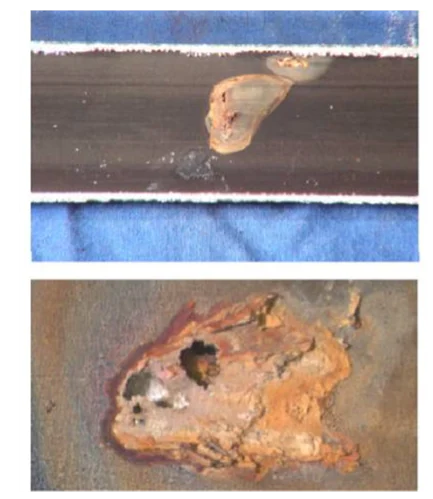
The second factor is chemical degradation. Water is rarely "pure" in a natural setting. As it travels through the atmosphere and over surfaces, it picks up dissolved gases, pollutants, acids, and salts. When this chemical soup settles on a painted surface, it initiates complex reactions. Acids can etch into materials, while salts—particularly in marine environments—can accelerate the oxidation of metal substrates, causing rust to bloom beneath the paint, eventually forcing the coating to buckle and fail.
These processes are well-documented, yet they have never fully explained why some coatings fail significantly faster than others under seemingly identical conditions. It is within this "knowledge gap" that the research team, led by the Max Planck Institute for Polymer Research, began their inquiry.
The Genesis of a Discovery: Friction Electricity
The research was spearheaded by Hans-Jürgen Butt, director at the Max Planck Institute for Polymer Research, in a cross-continental collaboration involving the University of Bonn, the South China University of Technology, MIT, and Johannes Gutenberg University Mainz.
The team’s journey toward this discovery began not with a focus on destruction, but with an investigation into the fundamental physics of liquid behavior. "A few years ago, we investigated the physics behind how water droplets become charged as they slide across surfaces," explains Rüdiger Berger, group leader in the ‘Physics at Interfaces’ department. "This is a kind of ‘friction electricity’ in droplets and is physically much more complex than previously assumed."
This concept, known as the triboelectric effect, occurs when two different materials come into contact and then separate, resulting in a transfer of electrons. While usually associated with rubbing a balloon against hair, the researchers realized that water droplets—when sliding over a surface—act as mobile capacitors. As they move, they accumulate an electrical charge.
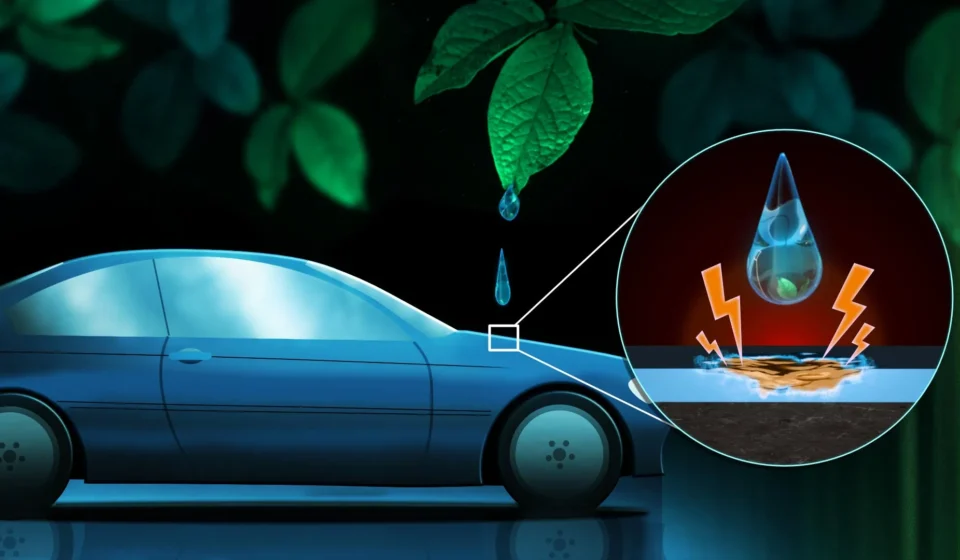
"When such charged droplets strike a coating, they discharge locally and can puncture the layer in specific spots like a small flash of lightning," Berger adds. This "lightning" is not a massive discharge visible to the naked eye, but a localized, high-energy event occurring at the scale of micrometers. Each droplet strike serves as a tiny electrical needle, piercing the protective armor of the material.
Testing the "Micro-Lightning" Hypothesis
To quantify the damage caused by these invisible electrical events, the team designed a series of controlled experiments. They selected Teflon—a material globally recognized for its non-stick and highly resilient properties—as the baseline "victim" surface.
The Baseline: Neutral Droplets
In the first phase of the experiment, the researchers dropped uncharged water droplets onto the Teflon surface. They subjected the material to 3,000 impacts, a significant number designed to mimic the repeated rainfall experienced by a structure over time. Following the experiment, microscopic examination revealed that the Teflon surface remained pristine. There was no visible degradation, no pitting, and no structural change to the underlying metal.
The Catalyst: Surface Interaction
In the second phase, the team introduced the variable of "surface charging." Before the droplets were allowed to hit the Teflon, they were rolled across various common materials, including a houseplant leaf, PVC (polyvinyl chloride), and polystyrene (the material used in plastic windows).
As the droplets traversed these materials, they accumulated a distinct electrical charge. When these now-charged droplets were released onto the Teflon, the results were drastically different. After 3,000 impacts, the microscopic analysis told a tale of destruction. There were clear, measurable changes not only in the protective Teflon coating itself but also in the metal substrate hidden beneath it.
The droplets had acted as conduits, carrying an electrical potential that, upon impact, discharged into the coating, creating microscopic fissures and pathways for future chemical damage to take hold.
Variables of Destruction: Why Materials Matter
A critical component of the study was determining whether the material the water crossed mattered. As it turns out, the "charging capacity" of the surface is a major factor in the severity of the damage.
"The charge a droplet acquires as it slides depends heavily on the specific surface—we measured differences of up to a factor of ten," explains Zhongyuan Ni, the study’s first author. "Regardless of this, we were able to detect changes in the coating in all experiments."
This discovery suggests that the environment surrounding a structure is just as important as the structure itself. A bridge surrounded by concrete might suffer different electrical degradation than one surrounded by vegetation or different plastic-based building materials, as each surface imparts a unique electrical signature to the rainfall before it hits the protected structure. The consistency of the damage across all tests, despite varying charge levels, confirms that even low-level electrical discharges are fundamentally detrimental to the long-term integrity of protective coatings.
Implications for Global Infrastructure
The publication of these findings in Nature has sent ripples through the fields of architecture, engineering, and material science. If "micro-lightning" is a primary, hitherto overlooked driver of decay, current methods of coating and maintenance may be fundamentally misaligned with the reality of the environment.
1. Cultural Heritage and Conservation
Many of the world’s most significant historical sites are composed of materials that are highly susceptible to this form of electrical erosion. Conservationists tasked with preserving statues, ancient masonry, and metalwork now have a new variable to consider. Protective sealants, which were previously chosen based on chemical resistance, may now need to be evaluated for their dielectric properties—their ability to resist or dissipate electrical charges.
2. Automotive and Aerospace Engineering
In the automotive industry, the pursuit of "forever-glossy" paint finishes is a multi-billion-dollar endeavor. If rain and road spray are electrically puncturing the clear-coat of a vehicle, manufacturers may need to develop additives that neutralize the charge of water droplets before they reach the paint, or reformulate coatings to be more electrically conductive to prevent the "lightning" effect.
3. The Future of Smart Coatings
The research opens the door to a new generation of protective materials. Instead of relying on passive barriers that simply "harden" against weather, the future may lie in "smart coatings" designed to manage electrical potential. These materials could potentially neutralize the charge of an incoming droplet upon contact, preventing the discharge event entirely.
Conclusion: A New Frontier in Maintenance
The identification of this hidden mechanism is a classic example of how fundamental research can shift our perspective on everyday problems. By peering into the microscopic physics of a single raindrop, the team led by the Max Planck Institute has provided a new lens through which to view the gradual aging of our world.
The Eiffel Tower and the Golden Gate Bridge will always require maintenance; the forces of nature are too vast to ignore. However, armed with the knowledge that water is an electrical weapon as much as it is a chemical or mechanical one, engineers can now begin to design the next generation of materials.
As the researchers look toward the future, the goal is clear: to create coatings that do not just repel water, but also withstand the invisible, electrified storm that accompanies every raindrop. Through this discovery, we move closer to a world where our structures endure, not by fighting nature, but by mastering the subtle physics that govern the interaction between the sky and the earth.