


Corrosion Control in Industrial Water Systems: Navigating the Perils of Pitting

By Brad Buecker, Senior Technical Consultant, SAMCO Technologies
Published May 19, 2026
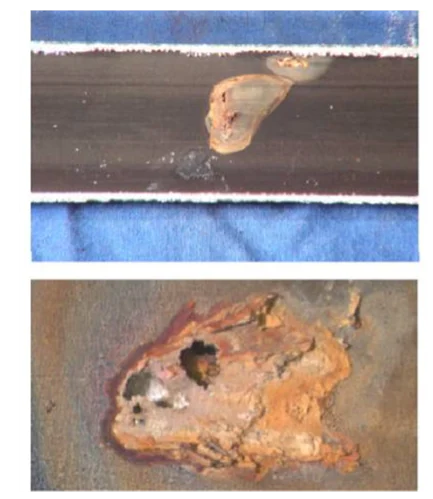
In the complex landscape of industrial water management, the battle against material degradation is ongoing. While general corrosion often grabs headlines due to the sheer volume of metal loss, it is localized corrosion that poses the most significant threat to plant reliability and fiscal health. Among these localized phenomena, pitting stands out as the most insidious and damaging mechanism. Unlike uniform corrosion, which thins components predictably, pitting targets specific, microscopic areas, allowing for deep, rapid penetration that can lead to catastrophic equipment failure in a matter of weeks.
This article serves as the third installment in a series examining major corrosion issues in industrial water systems. Having previously covered the fundamentals of electrochemical corrosion and the pervasive challenges of microbiological fouling, we now shift our focus to the mechanics, causes, and mitigation strategies surrounding pitting—a phenomenon that continues to plague cooling water systems and heat exchangers across the globe.
The Pitting Paradox: Why "Stainless" Doesn’t Mean "Stain-Free"
A recurring theme in industrial maintenance is the "knee-jerk" reliance on stainless steel as a universal panacea for corrosion issues. When a heat exchanger tube fails, a common refrain among engineers is, "Just upgrade to stainless steel." This approach is fundamentally flawed for several reasons.

First, "stainless steel" is a broad classification covering dozens of alloys, each with specific chemical and physical limitations. Second, the terminology itself is misleading; "stainless" does not imply the material is impervious to staining or, more importantly, corrosion. In many cases, the improper selection of a stainless grade can actually accelerate failure. History is replete with examples where 304 or 316 stainless steel tubes—often considered the industry standard—have suffered through-wall failures within as little as three weeks when placed in incompatible environments.
The Electrochemical Reality
At the microscopic level, a pit acts as a stationary anode. Once an initiate point is established, the chemistry inside the pit becomes drastically more aggressive than the surrounding bulk solution. This stagnant micro-environment traps acidic species and promotes rapid, self-sustaining metal dissolution. For austenitic stainless steels (like 304L and 316L), the protective oxide film is primarily composed of chromium (Cr). While this film is robust, it is highly susceptible to penetration by chloride ions. Once chlorides breach this layer, the metal beneath is exposed to localized, rapid electrochemical attack.
Chronology and Case Studies: Lessons from the Field
To understand the severity of pitting, one must look at real-world applications where material selection failed to account for water chemistry dynamics.
The Cooling Tower Concentration Crisis
During a two-year tenure reviewing specifications for combined-cycle power plants, my colleagues and I frequently encountered design documents that specified 304L or 316L stainless steel for steam surface condenser tubing. In every instance, these plants utilized recirculating cooling systems.
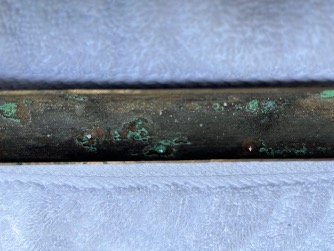
The physics of a cooling tower dictates that as water evaporates, impurities—including chlorides—concentrate significantly. A typical plant might see a four-to-six-fold increase in chloride levels compared to the makeup water. In arid climates, this "cycling up" can reach even higher, more extreme levels. Frequently, the design engineers failed to model these concentrated chemistry levels, resulting in a system where the chloride concentration far exceeded the metallurgical tolerance of the specified 304L stainless steel.
Wet Flue-Gas Desulfurization (WFGD) Failures
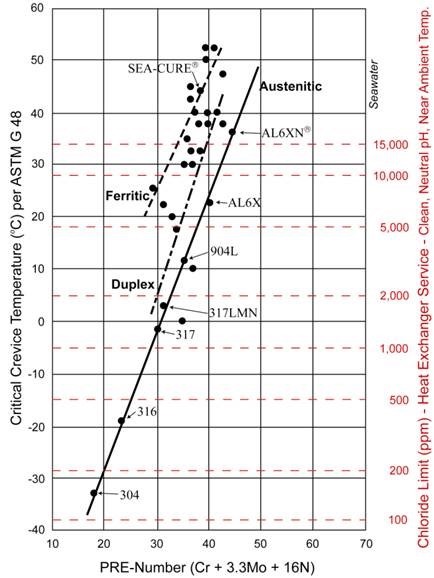
The power industry has also seen significant challenges in wet flue-gas desulfurization (WFGD) systems. In a coal-fired plant utilizing Illinois coal, the presence of chlorine led to the formation of soluble chloride salts in the scrubbers. Despite the high-performance requirements, the vendor utilized 904L stainless steel for the quencher vessels. The design failed to account for the reality that chloride concentrations frequently topped 10,000 ppm, far exceeding the 3,500 ppm threshold for 904L. The resulting pitting was so severe that even high-end organic coatings failed to protect the substrate, eventually requiring costly material upgrades or vessel replacements.

Supporting Data: The Pitting Resistance Equivalent Number (PREn)
To avoid the pitfalls of improper material selection, engineers must rely on empirical data, specifically the Pitting Resistance Equivalent Number (PREn). The PREn provides a standardized metric to evaluate an alloy’s resistance to chloride-induced pitting based on its chemical composition:
PREn = %Cr + 3.3(%Mo) + 16(%N)
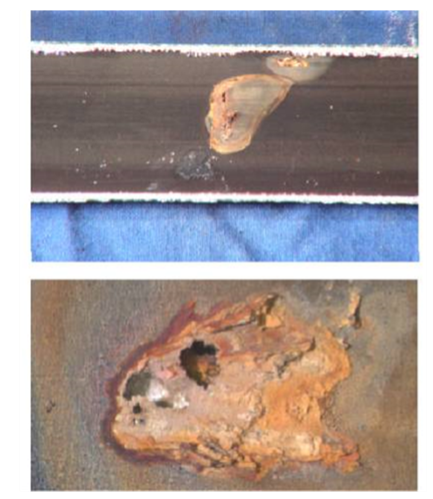
As the formula illustrates, chromium, molybdenum, and nitrogen are the primary drivers of chloride resistance. Notably, nickel—a major alloying element in 300-series stainless steels—contributes very little to chloride pitting resistance. This is a crucial distinction that many designers overlook. When faced with brackish water or seawater, standard austenitic steels are insufficient. Engineers must pivot toward ferritic or super-ferritic alloys, such as SEA-CURE®, to provide the necessary resistance.
Emerging Threats: Sulfides and Manganese
While chlorides are the most common culprits, they are not the only agents of destruction.

The Sulfide Menace
Sulfide ions (S²⁻) are exceptionally corrosive, particularly to copper-based alloys. In one notable case, a plant replaced aging Admiralty brass tubes with 90-10 copper-nickel alloy. Within 18 months, the new tubes suffered widespread through-wall penetrations. The forensic investigation revealed that the culprit was a sulfide-containing lubricant used during the fabrication process. The lubricant had not been properly cleaned, leaving a residue that catalyzed thousands of localized corrosion sites.
Manganese-Induced Pitting
Manganese presents a unique and often overlooked threat. Even at concentrations as low as 0.02 ppm, dissolved manganese can be oxidized by chlorination, forming a varnish-like layer of manganese dioxide (MnO₂) on tube surfaces. This layer is highly cathodic to the underlying metal, creating a classic "battery" effect that drives rapid, localized pitting.

This process is cyclical: during chlorination, the MnO₂ layer is oxidized to permanganate, which dissolves the base metal, before reducing back to MnO₂. This leaves the metal surface vulnerable to a repetitive, destructive cycle. 304 and 316 stainless steels, as well as several copper alloys, are highly susceptible to this specific mechanism.
Implications for Plant Reliability and Future Operations
The primary implication of these findings is that material selection is not a "set-it-and-forget-it" process. It requires a deep, ongoing understanding of the interplay between fluid chemistry, metallurgy, and operational conditions.
- System-Wide Audits: Plants must perform regular water chemistry audits. As raw water sources change or as operational cycles shift, the material compatibility of existing heat exchangers must be re-evaluated.
- Cross-Functional Expertise: Maintenance and engineering teams should consult with specialists who understand the electrochemical nuances of localized corrosion. The Association for Materials Protection and Performance (AMPP) remains the gold standard for industry guidance.
- Holistic Protection: Pitting is often the precursor to more severe issues, including corrosion fatigue and stress corrosion cracking (SCC). By controlling the initial pitting, plants can prevent these more catastrophic, structural-level failures.
A Note of Caution
Corrosion is not limited to metals. As this article was being finalized, reports emerged regarding the degradation of internal plastic components in a bleach pump. These components were designed for organic fluids but were misapplied in an oxidizing biocide service. This serves as a stark reminder that every component in an industrial water system—metallic or non-metallic—must be rigorously vetted for its specific service environment.
As we move toward the next installment of this series, we will delve deeper into other localized corrosion mechanisms and establish a framework for robust corrosion monitoring and control techniques. Reliability is built on the foundation of understanding the microscopic threats that, if left unchecked, can compromise the largest of industrial assets.
References
For the complete list of technical specifications, alloy composition charts, and detailed electrochemical studies referenced in this analysis, please consult the official archives of the Association for Materials Protection and Performance (AMPP) at www.ampp.org.