





Redefining Vehicle Architecture: How Zonal Systems are Revolutionizing Sensor Redundancy, Wiring, and Latency

As modern vehicles evolve into software-defined, autonomous data centers on wheels, the physical and electronic systems powering them are undergoing a structural revolution. For decades, the automotive industry relied on domain-based in-vehicle network architectures (DIA), grouping electronic control units (ECUs) and sensors by their specific functions—such as powertrain, infotainment, and body controls—and running extensive dedicated wiring harnesses back to centralized controllers.
Today, this functional approach is buckling under the weight of exponential technological growth. The integration of advanced driver-assistance systems (ADAS), high-resolution LiDAR, radar, cameras, and cross-domain features has made the traditional wiring harness one of the heaviest, most complex, and cost-prohibitive systems in a vehicle.
Enter the zonal-based in-vehicle network architecture (ZIA). By shifting from a function-based network to a geometry-based layout, the automotive sector is fundamentally rewriting the rules of sensor placement, communication latency, and fail-operational redundancy. However, while zonal architectures offer undeniable physical and performance advantages, they also introduce complex engineering challenges regarding safety-critical compliance and centralized computing stress.
Main Facts: The Core Shifts of Zonal Architecture
The transition to zonal vehicle architecture is not merely an incremental update; it represents a comprehensive overhaul of how power, data, and sensor signals are distributed across an automobile.
- Geometric vs. Functional Placement: Instead of routing sensors and ECUs based on what they do, zonal architectures group components by physical location. A typical vehicle layout splits the chassis into distinct physical zones—such as front-left, front-right, rear-left, and rear-right.
- The Rise of the Zone Control Unit (ZCU): Modern ZIA replaces decentralized functional controllers with localized Zone Control Units. These ZCUs act as local hubs for power distribution and data aggregation. External sensors connect to the nearest ZCU rather than running long dedicated cables across the entire vehicle body.
- Massive Harness Reductions: By shortening physical data runs, zonal consolidation drastically trims vehicle weight. At 120 ECUs, a 10-zone architecture can slash total wiring harness length by nearly 64% compared to a traditional five-domain layout.
- Latency Improvements: Because data crosses fewer switches and backbone links, critical high-priority control traffic experiences lower end-to-end (E2E) delays in a zonal system.
- The Redundancy Trade-Off: While zonal systems excel at physical packaging and weight savings, achieving ISO 26262 ASIL D (Automotive Safety Integrity Level D) compliance requires careful engineering. Consolidating functions into fewer zone controllers can magnify the impact of a single component failure, necessitating hybrid design strategies.
Chronology of an Architectural Evolution: From Domains to Zones
To understand where automotive networking stands today, it is essential to trace how vehicle electrical/electronic (E/E) architectures have evolved over time.

Phase 1: The Distributed ECU Era (Pre-2010s)
In the early days of automotive computing, every new feature—from power windows to anti-lock braking systems—was added by introducing a dedicated ECU and a dedicated wiring harness. As features multiplied, vehicles accumulated dozens, and eventually over a hundred, isolated microcontrollers. This created a nightmarish web of copper wiring, soaring vehicle weight, and severe manufacturing bottlenecks.
Phase 2: The Domain-Based Era (2010s – Early 2020s)
To tame the chaos of distributed ECUs, the industry shifted toward Domain-Based In-Vehicle Architectures (DIA). Vehicles were partitioned into functional domains (e.g., body, chassis, powertrain, cockpit, and ADAS). Each domain relied on a powerful domain controller to process data for that specific category. While this reduced the number of micro-controllers, the physical wiring problem persisted because sensors and actuators still had to span long distances across the chassis to reach their designated domain gateway.
Phase 3: The Emergence of Zonal and Centralized Compute (Present Day)
Recognizing that functional domains could no longer scale efficiently, automotive architects looked to aerospace and industrial automation for inspiration. They conceived the Zonal-Based In-Vehicle Network Architecture (ZIA). By merging local physical zones with a centralized high-performance computing unit (HPCU) serving as the vehicle’s "brain," engineers successfully decoupled physical connectivity from logical processing. Today, top-tier EV platforms and autonomous vehicle developers are actively deploying or piloting variations of zonal topologies.
Supporting Data: Harness Reductions, Latency, and Cost Metrics
Empirical studies published in technical literature—including research from journals such as Sensors, Energies, and IEEE Access—quantify the exact trade-offs of migrating from domain to zonal configurations.
1. Wiring Harness Savings
The physical benefit of zonal design scales directly with the number of zones and ECUs. When evaluating a vehicle system containing 120 ECUs:

- A traditional 5-domain DIA results in maximum harness length and complexity.
- An 8-zone ZIA achieves approximately a 61% reduction in total harness length.
- A 10-zone ZIA pushes total harness length reduction to an impressive 63.7%.
Independent industry estimates indicate that this reduction translates into a 15% to 20% drop in overall wiring harness weight. For electric vehicles (EVs), shedding pounds directly correlates with extended driving range and improved packaging flexibility.
2. End-to-End (E2E) Latency Analysis
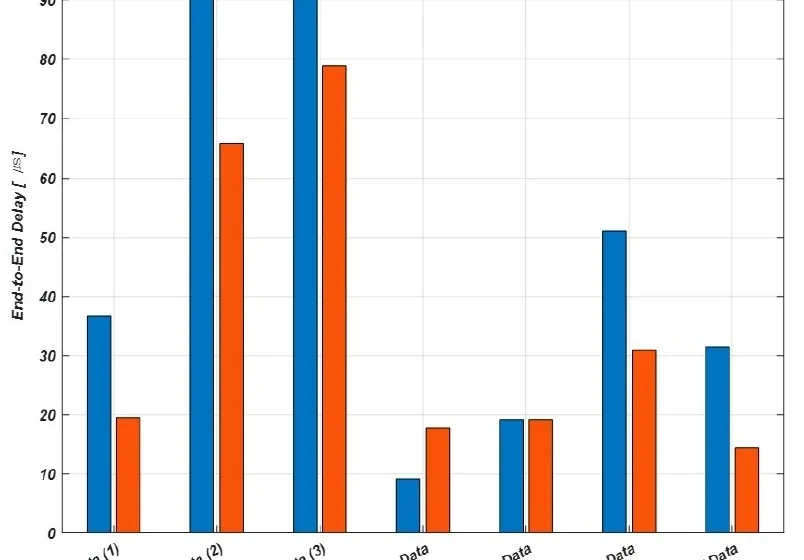
Safety-critical systems demand ultra-fast communication. Testing high-priority scheduled traffic reveals clear performance gains under zonal layouts:
- Primary Control Data Streams: E2E delay drops from 36.68 µs in domain architectures down to 19.52 µs in zonal configurations.
- Vehicle-to-Everything (V2X) Traffic: Latency decreases from 31.51 µs to 14.34 µs.
- Out of seven primary traffic types evaluated, five exhibited faster transmission speeds in ZIAs due to reduced intermediate switch hops. However, exceptions exist; navigation data latency increased from 9.16 µs to 17.74 µs, while high-bandwidth LiDAR data streams remained largely unaffected.
3. Redundancy, Cost, and Failure Probability
A comprehensive IEEE Access framework evaluated four distinct mapping options (domain vs. zonal, paired with vehicle-centralized or controller-based processing) under various redundancy scenarios.
- While controller-based zonal mappings yield the shortest cable lengths, they inherently increase hardware costs and elevate backbone communication loads.
- Conversely, domain controller-based mappings offer superior balance across failure probability, cost, and load metrics when stringent ASIL D safety redundancies are mandated.
Official Responses and Industry Perspectives
Automotive tier-1 suppliers, semiconductor manufacturers, and OEM engineering leads have expressed mixed yet pragmatic views regarding the widespread adoption of pure zonal architectures.
Industry consortia note that while the allure of copper reduction is powerful, safety cannot be compromised for the sake of wiring efficiency. According to functional safety experts specializing in ISO 26262 compliance, moving toward fail-operational autonomy means that the failure of a single zone controller cannot be allowed to disable critical vehicle steering, braking, or perception capabilities.

Consequently, major automakers are pivoting toward hybrid architectural models. Rather than jumping straight into a pure zonal system where all intelligence is stripped from the edges, engineers are deploying zonal layouts primarily for body, comfort, and low-priority auxiliary features, while maintaining dedicated, heavily protected domain or sub-domain pathways for core safety-critical driving controls.
Semiconductor vendors are responding by developing advanced Zone Control Units equipped with hardware virtualization, advanced fail-over mechanisms, and high-speed automotive Ethernet switch capabilities to handle the localized data flood securely.
Implications: What Zonal Redundancy Means for the Future of Mobility
The shift toward zonal architectures carries profound implications for vehicle manufacturing, supply chains, software development, and functional safety standards.
Manufacturing and Assembly Simplification
Wiring harnesses have traditionally been one of the last custom-built, labor-intensive components in vehicle manufacturing, often installed manually due to their flexibility and complex routing. By breaking the vehicle down into standardized physical zones with modular ZCUs, automakers can pre-assemble entire zonal sub-harnesses off-site. This modularity opens the door to automated robotic assembly, significantly lowering production times and manufacturing errors.
The Shift to Software-Defined Vehicles (SDVs)
Zonal architecture acts as the hardware bedrock for true Software-Defined Vehicles. By centralizing high-performance computing and standardizing local data collection through ZCUs, automakers can push over-the-air (OTA) updates more efficiently. New features can be integrated via software rather than requiring physical rewiring or ECU additions, drastically shortening development cycles.

Redefining Sensor Redundancy and Fault Tolerance
In fully autonomous vehicles operating without a human safety driver, sensor redundancy is non-negotiable. If a primary camera or LiDAR sensor fails, a secondary sensor must instantly take over without perceptible lag. Zonal systems facilitate this by allowing ZCUs to locally cross-check and merge redundant sensor streams before transmitting them to the central brain.
However, because zonal layouts concentrate processing power, engineers must design robust fail-operational fallback loops. If a primary ZCU suffers a power interruption or physical damage during a collision, secondary power lines and overlapping zonal coverage zones must seamlessly maintain vehicle control.
Conclusion: The Road Ahead
Zonal architectures are undeniably reshaping sensor redundancy, wiring efficiency, and network latency from the ground up. Geometric sensor placement and localized ZCUs deliver staggering reductions in harness weight and improve reaction times for critical safety data.
Yet, the road to a purely zonal automotive ecosystem is paved with complex trade-offs. The high cost of fail-operational redundancy and increased backbone communication loads mean that pure zonal mapping is not yet a universal panacea. For the immediate future, the industry is converging on intelligent hybrid designs—leveraging zonal efficiency for comfort and body systems while retaining structured domain balances for high-integrity safety control. As technology matures, zonal architecture will remain the defining backbone of the next generation of smart, autonomous transportation.