




The Fabric of Time: How Quantum Collapse Models Are Rewriting the Rules of Reality

Quantum mechanics has long stood as the most successful, yet profoundly unsettling, framework in the history of science. While it governs the behavior of atoms and subatomic particles with astonishing precision, it presents a reality that defies human intuition. In this microscopic realm, particles exist in a state of "superposition," occupying multiple positions or energy states simultaneously. This fluid reality is described by the wavefunction—a mathematical entity that maps out probabilities rather than certainties.
However, we do not live in a world of ghosts and shadows. In our macroscopic reality, objects possess definite locations and single states. To bridge the chasm between the quantum "everything-at-once" and the classical "one-place-at-a-time," standard quantum mechanics relies on the concept of wavefunction collapse: the idea that the moment a system is observed or measured, its myriad possibilities vanish, leaving behind a single, concrete outcome.
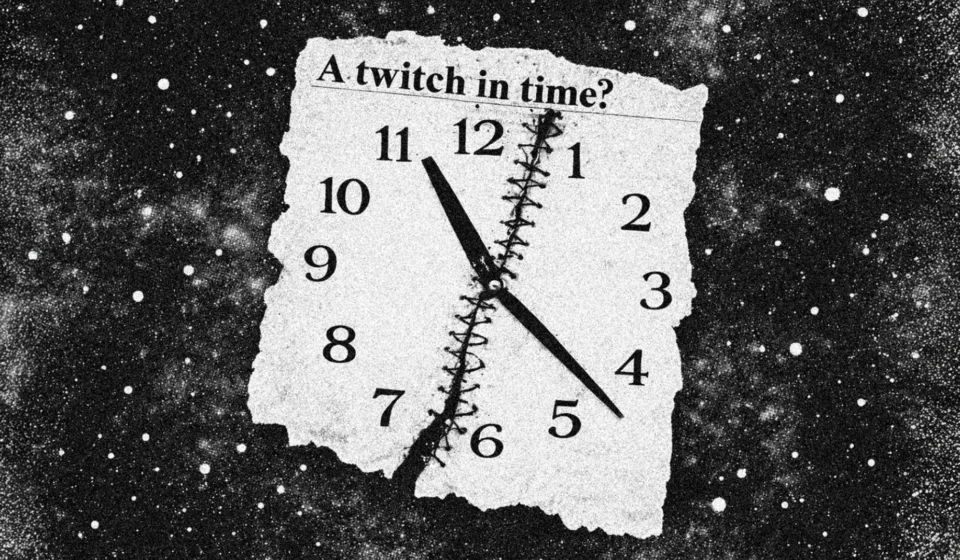
Now, a pioneering study published in Physical Review Research suggests that this standard explanation may be incomplete. Supported by the Foundational Questions Institute (FQxI), an international team of physicists has proposed that wavefunction collapse might not be a result of observation, but a spontaneous, physical process linked to the very geometry of the universe. This radical shift in perspective implies that time itself may possess an inherent, fundamental uncertainty—a "fuzziness" that could serve as the long-sought bridge between quantum mechanics and gravity.
The Evolution of Quantum Theory: From Observers to Spontaneous Collapse
To understand the weight of these findings, one must look at the historical trajectory of quantum theory. Since the inception of the Copenhagen interpretation in the early 20th century, the "measurement problem" has remained a thorn in the side of physicists. If quantum mechanics is universal, why does it only apply to small things? What constitutes a "measurement"?
In the 1980s, a new generation of theorists sought to remove the "observer" from the equation. They developed "collapse models," which posit that wavefunctions collapse spontaneously and randomly, independent of human interaction. Unlike standard interpretations—which are often philosophical or mathematical restatements of existing theory—these collapse models are bold. They make specific, testable predictions about physical phenomena that differ from standard quantum mechanics.
Nicola Bortolotti, a PhD student at the Enrico Fermi Museum and Research Centre (CREF) in Rome and the lead author of the new study, notes that the team’s objective was to ground these abstract theories in the physical reality of spacetime. "What we did was to take seriously the idea that collapse models may be linked to gravity," Bortolotti explains. "We asked a very concrete question: What does this imply for time itself?"
Chronology of a Theoretical Breakthrough
The research team, which includes eminent figures such as Catalina Curceanu (INFN-LNF), Kristian Piscicchia (CREF), Lajos Diósi (Wigner Research Center for Physics), and Simone Manti (INFN-LNF), approached the problem by examining two distinct collapse models:
- The Diósi-Penrose Model: Named after Lajos Diósi and Sir Roger Penrose, this framework suggests that the gravitational field itself is the catalyst for collapse. According to this model, when a quantum system reaches a certain gravitational threshold, it can no longer maintain a superposition and must collapse into a definite state.
- Continuous Spontaneous Localization (CSL): This model suggests that collapse is a continuous, universal process happening to all particles at all times, with a specific rate of occurrence.
For the first time, the research team successfully established a quantitative link between CSL and gravitational fluctuations in spacetime. By mathematically mapping how these collapses interact with the geometry of the universe, the team reached a startling conclusion: time is not the perfectly smooth, independent backdrop that classical physics assumed. Instead, it contains a microscopic, inherent uncertainty.
Supporting Data: Why Time Has a "Built-In" Uncertainty
The implications of this "intrinsic uncertainty" are profound, yet the researchers are quick to emphasize that this is not a crisis for modern technology. The effect is so minuscule that it remains beneath the sensitivity threshold of our most advanced instrumentation.
"Once you do the calculation, the answer is clear and surprisingly reassuring," says Bortolotti.
The team’s data indicates that even the world’s most precise atomic clocks—which measure time by tracking the oscillations of atoms—are currently nowhere near sensitive enough to detect the "jitter" caused by these spontaneous collapses. Catalina Curceanu notes that the uncertainty exists at such a low order of magnitude that it has zero practical consequences for everyday timekeeping. "Our results explicitly show that modern timekeeping technologies are entirely unaffected," adds Kristian Piscicchia.
However, the fact that the effect exists at all is the real "smoking gun." In physics, the presence of a fundamental limit usually signals that we are brushing against the boundaries of a more comprehensive theory.
Bridging the Great Divide: Quantum Mechanics vs. Gravity
The conflict between quantum mechanics and Einstein’s General Relativity is perhaps the most significant hurdle in contemporary science. Quantum mechanics treats time as an external, immutable "clock" ticking in the background—a parameter that remains untouched by the particles it measures. Conversely, General Relativity treats time as a flexible, dynamic component of spacetime that bends, warps, and stretches in response to mass and energy.
These two views are fundamentally incompatible. When physicists attempt to merge them into a theory of "Quantum Gravity," the math typically breaks down into infinities. The new study suggests that collapse models might be the missing link. If gravity is indeed the mechanism that forces quantum systems to "choose" a state, then gravity and quantum mechanics are not separate realms, but two sides of the same coin.
By revealing that collapse models lead to a fundamental uncertainty in time, the researchers have identified a specific "fingerprint" that might distinguish their theories from standard quantum mechanics. This creates a roadmap for future experiments. If we can build detectors sensitive enough to measure the ultra-faint ripples caused by spontaneous collapse, we might finally observe the point where quantum theory and gravity intersect.
Official Responses and Future Implications
The international scientific community has long debated whether the "foundations" of physics deserve the same funding and attention as applied technologies. The support provided by FQxI for this research underscores the belief that the most profound advancements often come from questioning our most basic assumptions.
"There are not many foundations in the world which are supporting research on these types of fundamental questions about the universe, space, time, and matter," says Curceanu. She highlights the necessity of maintaining a balance between high-tech application and deep, theoretical inquiry.
The research team is already looking toward the next phase: experimental verification. While existing atomic clocks are not yet precise enough, the study provides the necessary theoretical framework to guide the next generation of experiments. As sensor technology evolves, the potential to test these "radical ideas" becomes more tangible.
The Path Forward
The significance of this work lies in its refusal to accept the "standard" interpretation as the final word. By mathematically linking the collapse of wavefunctions to the nature of spacetime, Bortolotti and his colleagues have shifted the conversation from abstract philosophy to concrete, physical prediction.
If their hypothesis holds, the clockwork of the universe is not as rigid as we once believed. Instead, at the very bottom of the reality we perceive, there is a subtle, persistent tremor—a reminder that time, space, and matter are woven into a single, complex, and still-mysterious fabric.
As we continue to push the boundaries of precision measurement, we may find that what we once dismissed as "measurement error" or "theoretical noise" is actually the heartbeat of a deeper, unified physics waiting to be discovered. For now, the pillars of timekeeping remain stable, but the foundation beneath them is being rewritten, one quantum collapse at a time.