
Weaving the Future: Mobile Robotics Steps Beyond the Automotive Factory and Into the Textile Industry

By: Industrial Automation & Robotics Desk
Sponsored in part by Mouser Electronics
Main Facts
The landscape of industrial automation is undergoing a seismic shift. For decades, robotic integration was largely the domain of high-profile, heavy-duty sectors—most notably the automotive, aerospace, and major appliance manufacturing industries. In these spaces, gargantuan, fixed-base robotic arms have welded chassis, painted bodies, and bolted components together with high precision. However, these traditional systems come with significant limitations: they are bolted to the floor, require dedicated safety caging, and lack the flexibility to adapt to unstructured environments or work collaboratively alongside human operators without posing safety risks.
Today, a new chapter in manufacturing technology is being written. The convergence of advanced sensor technologies, sophisticated artificial intelligence, compliant motion control, and autonomous navigation has given rise to a new breed of automation: mobile robotics. Leading this charge is PAL Robotics, a pioneer in humanoid and mobile robotic solutions, which has recently demonstrated complex motion control and collaborative dexterity in one of the world’s oldest and most labor-intensive industries: textiles.
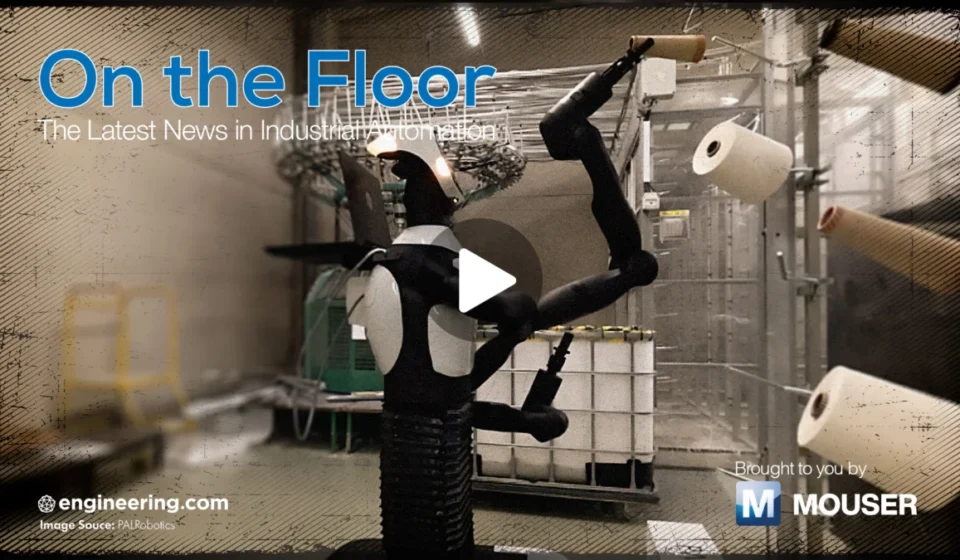
According to data released by the International Federation of Robotics (IFR), a groundbreaking pilot program is currently underway at CETRIKO, a prominent Spanish textile manufacturer. This initiative marks a pivotal departure from traditional factory automation by deploying the TIAGo Pro—a state-of-the-art mobile manipulator developed by PAL Robotics.
The core objectives and facts of the deployment include:
- The Application: The TIAGo Pro robot is tasked with automating the lifting, handling, and precise positioning of heavy yarn cones—a historically strenuous, highly repetitive manual task that frequently led to operator fatigue and repetitive strain injuries (RSIs).
- The Technology: Unlike fixed industrial arms, the TIAGo Pro combines a mobile base (Autonomous Mobile Robot, or AMR) with an articulated robotic arm and advanced end-effectors, allowing it to navigate the factory floor dynamically and manipulate objects at human-scale heights.
- The Collaboration: The robot is operating safely in shared workspaces next to human workers, demonstrating advanced collision avoidance, force feedback, and human-robot interaction (HRI) capabilities.
- The Broader Trend: This pilot signals a broader industrial migration. As mobile robotics technology matures, sectors that previously found automation cost-prohibitive or physically impractical—such as textiles, logistics, food processing, and pharmaceuticals—are finally reaping the productivity benefits of smart robotics.
Chronology of an Industrial Evolution: How Mobile Robotics Reached the Textile Floor
To understand the significance of PAL Robotics’ deployment at CETRIKO, it is necessary to trace the evolutionary path that brought mobile robotics from academic research laboratories to the bustling, intricate floors of textile manufacturing plants.
Phase I: The Era of Fixed Automation (1960s–2000s)
For nearly half a century, industrial robotics was synonymous with rigidity. Introduced in the automotive sector, robots like Unimate and its successors were designed for brute-force repetition. They excelled in predictable, closed environments where every millimeter of space was mapped out in advance.
However, industries characterized by soft materials, variable textures, and constantly shifting inventory—such as garments and textiles—remained largely untouched by this wave of automation. Handling limp fabric, delicate threads, and varied yarn weights proved nearly impossible for rigid industrial grippers operating on pre-programmed, unyielding trajectories.
Phase II: The Rise of Autonomous Mobile Robots (2010s)
The 2010s heralded the arrival of Automated Guided Vehicles (AGVs) and, subsequently, Autonomous Mobile Robots (AMRs). Powered by simultaneous localization and mapping (SLAM) algorithms, LiDAR sensors, and improved battery technology, these mobile bases began transporting materials across warehouses and manufacturing floors. While they revolutionized intralogistics, they remained essentially "transport systems on wheels." They could move a pallet from Point A to Point B, but they lacked the manipulative capability to interact with the environment upon arrival.
Phase III: The Convergence of Mobility and Manipulation (Late 2010s–Present)
The true turning point arrived when roboticists successfully mounted collaborative robot arms (cobots) onto mobile bases, creating "mobile manipulators." This innovation bridged the gap between locomotion and dexterity.
PAL Robotics, headquartered in Barcelona, Spain, recognized this potential early on. The company developed the TIAGo (Take It And Go) platform as a research tool, steadily upgrading its software, perception capabilities, and hardware resilience. Over the past five years, PAL Robotics transitioned TIAGo from academic settings into rigorous industrial validation programs.
Phase IV: The CETRIKO Pilot Program (Present Day)
The culmination of this technological trajectory is the ongoing pilot at CETRIKO. By integrating the TIAGo Pro mobile manipulator into an active textile production environment, PAL Robotics and CETRIKO have crossed a major threshold. The project moves mobile robotics past the conceptual stage and embeds it directly into the daily rhythms of textile manufacturing—handling heavy yarn cones, navigating narrow factory aisles, and working shoulder-to-shoulder with human textile artisans.
Supporting Data & Market Analysis
The integration of mobile manipulators into non-traditional sectors like textiles is not happening in a vacuum. It is supported by compelling macroeconomic trends, labor shortages, and empirical data from international robotics organizations.
The International Federation of Robotics (IFR) Insights
According to recent statistical reports from the IFR, the global deployment of professional service robots and industrial mobile robots has experienced exponential growth. While industrial robot installations reached record highs overall, the fastest-growing segment consists of robots capable of operating outside traditional safety cages.
- Growth in Mobile Manipulators: Market research indicates a compound annual growth rate (CAGR) of over 20% for mobile robotics in non-automotive sectors through the end of the decade.
- Labor Shortages as a Catalyst: In the textile and apparel sectors, demographic shifts and labor shortages have severely impacted production capacities. In regions across Southern Europe, finding workers willing to perform repetitive, physically demanding tasks like lifting heavy yarn cones has become increasingly difficult.
- Ergonomic Impact: Studies cited in industrial ergonomics literature show that manual handling of loads exceeding 10 kilograms in repetitive motions accounts for nearly 40% of workplace musculoskeletal disorders in light manufacturing. Automating these specific tasks via robots like TIAGo Pro directly correlates with a reduction in workers’ compensation claims and absenteeism.
Technical Specifications and Capabilities: PAL Robotics’ TIAGo Pro
To achieve the reliability required on a live manufacturing floor, the TIAGo Pro relies on a sophisticated stack of hardware and software components, many of which are enabled by modern electronic components supplied by industry leaders like Mouser Electronics:
| Feature Category | Technological Implementation | Operational Benefit |
|---|---|---|
| Locomotion | Omni-directional mobile base with LiDAR and depth cameras | Navigates tight, dynamic corridors alongside human workers without fixed tracks. |
| Manipulation | Dual-arm or single-arm articulated cobot with force-torque sensors | Delivers human-like dexterity, allowing safe interaction and delicate handling of variable payloads. |
| Perception | On-board RGB-D cameras and neural processing units | Enables real-time object recognition, pose estimation, and obstacle avoidance. |
| Power Management | High-density lithium-ion battery packs with smart charging | Supports continuous multi-shift operations with autonomous docking capabilities. |
Official Responses and Industry Perspectives
The collaboration between PAL Robotics and CETRIKO has garnered significant attention from industry leaders, automation engineers, and manufacturing executives who see the project as a bellwether for the future of factory floors.
PAL Robotics Leadership
In statements regarding the deployment of the TIAGo Pro, representatives from PAL Robotics emphasized that the primary design philosophy of their mobile manipulators is human-centric automation.
"For too long, industrial robotics meant isolating machines behind physical barriers to protect human workers," noted a senior robotics engineer at PAL Robotics. "With TIAGo Pro, we are breaking down those barriers. The textile industry presents unique challenges—loose materials, dynamic environments, and heavy, repetitive physical demands. By combining advanced mobility with sensitive, compliant manipulation, our robots can step right into these workflows, taking the strain off human operators and allowing them to focus on quality control, design, and higher-value tasks."
Textile Manufacturing Executives (CETRIKO)
CETRIKO’s operational team highlighted the necessity of adopting flexible automation to remain globally competitive. Operating in the European textile market requires a delicate balance of cost efficiency, high quality, and rapid turnaround times.
"Integrating mobile robotics was initially viewed with cautious optimism," shared a plant operations manager at CETRIKO. "Our workers were accustomed to traditional methods of sorting and moving yarn cones. However, seeing the TIAGo Pro operate safely right beside them changed that perception immediately. The robot handles the heavy, monotonous lifting—tasks that cause physical fatigue by the end of a long shift. Our staff can now redirect their energy toward monitoring production quality and managing complex textile patterns. It is not about replacing our workforce; it is about augmenting their capabilities and creating a safer, more sustainable work environment."
Electronics and Component Suppliers
The success of advanced robotics in rugged industrial environments relies heavily on the reliability of underlying electronic components. Through sponsorship and technical support from distributors like Mouser Electronics, developers gain access to cutting-edge microcontrollers, sensors, power management integrated circuits, and communication modules that ensure robotic systems can withstand the thermal, mechanical, and electrical stresses of continuous factory operation.
"Modern industrial robots are essentially edge-computing powerhouses on wheels," remarked an automation components specialist. "The reliability demanded in applications like the CETRIKO pilot means every capacitor, connector, and sensor must perform flawlessly under harsh conditions. Ensuring robust supply chains for these components is vital to keeping collaborative mobile robots operational 24/7."
Implications: The Broader Impact on Global Manufacturing
The successful trial of PAL Robotics’ TIAGo Pro at CETRIKO carries profound implications that stretch far beyond the Spanish textile sector. It serves as a micro-case study for the future of global manufacturing, touching upon labor dynamics, economic resilience, and technological innovation.
1. The Democratization of Industrial Automation
Historically, only massive corporations with deep pockets could afford the engineering overhead required to automate their production lines. Fixed-base robotic systems demanded custom-engineered safety cells, specialized structural foundations, and extensive programming.
Mobile manipulators dramatically lower this barrier to entry. Because they are mobile and equipped with advanced onboard navigation and perception systems, they require minimal facility modifications. A factory does not need to be rebuilt to accommodate a TIAGo Pro; the robot adapts to the existing environment. This democratization opens up automation to small and medium-sized enterprises (SMEs) in sectors like textiles, furniture, food packaging, and electronics assembly.
2. Redefining Human-Robot Collaboration (HRC)
The fear of job displacement has historically shadowed the robotics industry. However, deployments like the one at CETRIKO highlight a different narrative: coexistence and augmentation.
Textile manufacturing involves nuances—such as assessing the tension, grade, and quality of delicate fibers—that require human intuition and sensory skills. By offloading the ergonomic nightmare of repeatedly lifting heavy yarn cones to mobile robots, manufacturers protect their human workforce from injury while leveraging human cognitive strengths. The human worker transitions from a manual laborer to a "robot supervisor" or process technician, elevating job satisfaction and skill levels.
3. Supply Chain Resilience and Reshoring
For decades, many Western brands outsourced textile and apparel manufacturing to regions with vast pools of inexpensive manual labor. However, recent global supply chain disruptions, rising transportation costs, and a growing emphasis on sustainable, locally sourced production have triggered a wave of interest in reshoring manufacturing operations.
Technologies like mobile robotics are critical enablers of this reshoring trend. By automating the most labor-intensive bottlenecks of textile production—such as material handling, transport, and sorting—high-wage nations can offset labor cost disparities. This allows manufacturing to return closer to consumer markets, reducing carbon footprints and increasing supply chain agility.
4. Technical Challenges Ahead and Future Outlook
Despite the success of the CETRIKO pilot, industry experts note that challenges remain before mobile manipulators achieve ubiquitous adoption in textiles:
- Tactile Sensing: Handling soft, deformable, and fibrous materials like yarn and fabric requires sophisticated tactile sensors and adaptive grippers that are still evolving.
- Power Autonomy: While battery technology is improving, achieving true multi-shift continuous operation without frequent recharging breaks remains an engineering hurdle.
- Standardization: Integrating mobile robots with legacy factory machinery and disparate manufacturing execution systems (MES) requires ongoing software standardization.
Nevertheless, the trajectory is clear. As demonstrated by PAL Robotics and CETRIKO, the boundary between heavy industrial automation and flexible service robotics is dissolving. The factory floor of tomorrow will not be a sterile, human-free zone dominated by caged behemoths, but a dynamic, collaborative ecosystem where mobile robots and human artisans work side-by-side to weave the products of the future.