


Festo Unveils Enhanced VTUX Valve Terminal: A Leap Forward in Decentralized Pneumatic Control and Robotic Efficiency

Main Facts
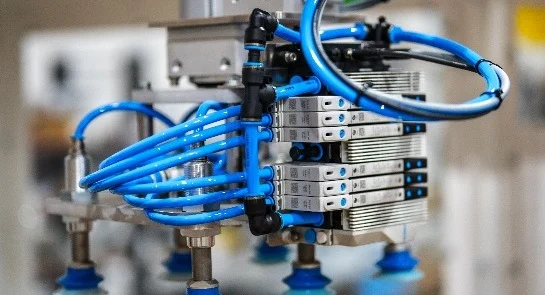
Festo, a global leader in automation technology, has announced significant updates to its VTUX valve terminal, a pivotal solution engineered to revolutionize end-of-arm tooling (EOAT) applications for robots and streamline decentralized pneumatic control across industrial environments. The refreshed VTUX platform represents a strategic advancement, integrating pneumatic control, vacuum generation, and comprehensive I/O capabilities into a single, compact, and energy-efficient unit. Designed for direct mounting at the point of actuation, this modular system promises to unlock new levels of performance, efficiency, and flexibility for original equipment manufacturers (OEMs) and end-users alike.
At its core, the updated VTUX is engineered to tackle some of the most pressing challenges in modern industrial automation: reducing energy consumption, enhancing data visibility at the operational front, and simplifying complex control architectures. Its innovative design minimizes compressed-air usage through sophisticated eco-functions, provides real-time pressure and vacuum data precisely where it’s needed, and facilitates seamless decentralized installation on moving machine elements or other critical locations. The introduction of advanced eco-functionalities for both vacuum and pressure, coupled with a robust multiprotocol interface and the new CTED module for network expansion, positions the VTUX as a cornerstone for intelligent, connected, and sustainable manufacturing processes. This latest iteration underscores Festo’s commitment to driving efficiency and intelligence closer to the point of action, ultimately contributing to more agile, responsive, and cost-effective automation solutions.
Chronology: The Evolution Towards Decentralized Intelligence
Festo’s journey in industrial automation has long been characterized by a relentless pursuit of innovation, particularly in pneumatic and electric drive technologies. From its origins as a woodworking machine manufacturer in 1925, Festo has evolved into a global powerhouse, consistently pioneering advancements that shape the future of manufacturing. The development of the VTUX valve terminal is not an isolated event but rather a logical progression within this rich history, reflecting broader industry trends towards miniaturization, energy efficiency, and decentralized control.
For decades, industrial control systems relied heavily on centralized architectures, with valve terminals often located in control cabinets, far from the actuators they commanded. While effective, this approach often led to longer tubing runs, increased response times, higher energy losses due and significant complexity in wiring and installation. As automation became more sophisticated and robotic applications proliferated, the demand for more agile, compact, and efficient control solutions grew exponentially.
Festo responded to these evolving needs by developing increasingly integrated and modular valve terminal solutions. The initial VTUX valve terminal was a significant step in this direction, offering a compact footprint and basic integration capabilities. However, the rapidly accelerating pace of Industry 4.0 and the Industrial Internet of Things (IIoT) mandated further enhancements. Manufacturers began demanding not only more compact and efficient components but also those capable of providing rich diagnostic data, seamless network connectivity, and greater adaptability to diverse communication protocols.
The current updates to the VTUX valve terminal are a direct response to these demands, representing the latest chapter in Festo’s ongoing commitment to pushing the boundaries of pneumatic control. By refining its eco-functions, embedding advanced sensing and processing capabilities, and introducing the multiprotocol CTED module, Festo is not merely upgrading a product; it is reaffirming its leadership in enabling the next generation of smart factories. This evolution reflects a strategic vision to empower OEMs with the tools to build more intelligent, sustainable, and flexible automation systems, directly addressing the challenges of a rapidly digitalizing industrial landscape. The emphasis on decentralized intelligence and plug-and-play connectivity showcases Festo’s forward-thinking approach, ensuring its solutions remain at the forefront of industrial innovation.
Supporting Data: Unpacking the VTUX’s Performance and Features
The enhanced Festo VTUX valve terminal stands out through a meticulously engineered suite of features designed to deliver tangible operational benefits. These innovations span critical areas such as energy conservation, data acquisition, and architectural flexibility, directly addressing the core needs of modern industrial automation.
Pneumatic Efficiency Redefined: The Eco Functions
One of the most compelling aspects of the updated VTUX is its advanced eco-functions, which fundamentally alter the paradigm of compressed-air consumption in industrial applications. Compressed air is notoriously expensive to generate, and any reduction in its use translates directly into significant operational cost savings and a smaller environmental footprint.
Vacuum-Side Optimization: The VTUX employs a sophisticated threshold-based control mechanism for vacuum generation. Unlike conventional systems that maintain a continuous vacuum, often leading to unnecessary air consumption, the VTUX activates vacuum generation only when needed. The system precisely monitors vacuum levels within defined limits. If the vacuum pressure drops below a pre-set threshold, the system intelligently engages to restore it. Once the desired level is achieved, it deactivates, conserving air. This intelligent, on-demand operation can lead to a remarkable reduction in compressed-air usage by up to 20% to 30%. This not only cuts energy costs but also ensures consistent and reliable grip for EOAT applications, preventing drops or slippage while minimizing resource waste. The precision of this control is critical in applications where sensitive parts are handled, ensuring consistent force without over-consumption.
Pressure-Side Load Matching: For pneumatic actuators, the VTUX introduces eco-functions that optimize pressure delivery based on the specific load and motion profile. In many applications, actuators are supplied with a constant, often higher-than-necessary, pressure to ensure reliable operation under peak loads. The VTUX, however, incorporates a short learning phase during initial operation. During this phase, it intelligently determines the minimum pressure required to complete the desired motion profile for a given load. Once this optimal pressure is identified, the system dynamically adjusts the air supply, preventing the use of excess air. This adaptive pressure control can slash compressed-air consumption for actuators by an impressive 40% while rigorously maintaining the required performance. This not only yields substantial energy savings but also reduces wear and tear on actuators and other pneumatic components, extending their lifespan and reducing maintenance frequency. The ability to dynamically adjust pressure also allows for greater precision in movement, especially beneficial in applications requiring delicate handling or precise positioning.
Integrated Intelligence and Decentralized Operation
The VTUX’s design philosophy centers on bringing intelligence and control closer to the point of action. This strategy offers multiple advantages:
Point-of-Use Data: Integrated sensors and processing capabilities within the VTUX provide real-time pressure and vacuum data directly at the point of use. This immediate access to critical operational parameters is invaluable for diagnostics, process monitoring, and predictive maintenance strategies. Instead of relying on centralized sensors that may not accurately reflect conditions at the gripper or actuator, the VTUX offers precise local data. This granular insight empowers operators and maintenance teams to quickly identify anomalies, optimize processes, and troubleshoot issues, significantly reducing downtime and improving overall operational transparency. It’s a key enabler for advanced analytics and condition monitoring in IIoT ecosystems.
Simplified Specification and Assembly for OEMs: The functional integration of pneumatic control, vacuum generation, and I/O into a single modular unit dramatically simplifies the design and engineering process for OEMs. Instead of sourcing and integrating separate components, OEMs can leverage the VTUX as a comprehensive solution. This consolidation reduces the bill of materials (BOM), minimizes wiring and tubing complexity, and accelerates assembly times, leading to lower manufacturing costs and faster time-to-market for their machines.
Decentralized Installation Benefits: The VTUX is purpose-built for decentralized installation, allowing it to be mounted directly on moving elements of a machine, such as robot arms or gantry systems, or positioned strategically elsewhere on the machine. Its lightweight polymer construction is crucial for robotic applications, where reducing moving mass is paramount for maximizing speed, acceleration, and payload capacity. This decentralization significantly reduces the length of pneumatic tubing and electrical wiring, which in turn leads to:
- Improved Response Times: Shorter tubing means less volume to fill, resulting in faster and more precise actuator responses.
- Lower Overall Energy Consumption: Reduced pressure losses over shorter distances and improved response efficiency contribute to overall system energy savings.
- Enhanced Machine Design Flexibility: Designers are no longer constrained by the need to house all control components in a central cabinet, opening up possibilities for more compact, streamlined, and optimized machine layouts.
Modular Architecture for Future-Proofing: The VTUX’s modular architecture allows for easy configuration and expansion. As production requirements change or new functionalities are needed, modules can be added or swapped without requiring a complete system overhaul. This inherent flexibility protects initial investments and ensures that automation systems can adapt to evolving demands, making them truly future-proof.

Decentralized Intelligence and Seamless Networking with CTED
In an era of increasingly distributed machine architectures, the ability to effortlessly integrate new components and diagnostics without extensive redesign is critical. The CTED module addresses this head-on:
Network Expansion without Re-engineering: The CTED module provides a decentralized option for expanding VTUX valve terminal networks. This means OEMs can add more valves and I/O points to their systems without the need to re-engineer the host control architecture. This capability is invaluable for scalability and allows for agile adjustments to production lines.
Multiprotocol Connectivity: A standout feature of the CTED module is its configurability to major industrial fieldbus protocols, including EtherNet/IP, PROFINET, EtherCAT, CC-Link, and Modbus TCP. This multiprotocol capability is a game-changer for OEMs operating across diverse global markets or those needing to integrate into existing brownfield installations with various control systems. It eliminates the need to stock separate communication modules or entirely different valve terminals for each protocol, simplifying specification, inventory management, and global standardization efforts. This significantly reduces complexity and costs associated with managing multiple SKUs and ensures seamless integration regardless of the customer’s preferred control platform.
Enhanced Diagnostics via Serial Interface: Unlike older parallel bridge interfaces, the CTED uses a serial interface to connect with the VTUX valve terminal. This allows for the transmission of rich diagnostic data and sensor feedback directly through the terminal and back to the main control system. This means that critical information about valve status, pressure levels, vacuum performance, and connected sensor readings is readily available for machine operation and maintenance. This comprehensive diagnostic capability is a cornerstone for proactive maintenance strategies, predictive failure analysis, and overall system optimization, further enhancing the VTUX’s value in an Industry 4.0 context.
Finally, the fact that VTUX valve terminals are assembled and tested prior to shipment at Festo’s Regional Service Center in Mason, Ohio, underscores a commitment to quality, localized support, and efficient supply chain management, particularly for the North American market. This regional focus ensures higher quality control, faster delivery times, and readily available technical support.
Official Responses: Festo’s Vision for Smart Automation
While the original article does not contain direct quotes, the technological advancements embedded within the updated VTUX valve terminal strongly articulate Festo’s strategic direction and commitment to its customers. A hypothetical statement from a Festo executive would likely emphasize the company’s dedication to innovation, efficiency, and customer-centric solutions.
"At Festo, we are constantly pushing the boundaries of what’s possible in industrial automation," a Festo spokesperson might state. "The enhanced VTUX valve terminal is a testament to this commitment. We recognize the evolving demands on OEMs to deliver machines that are not only faster and more precise but also significantly more energy-efficient and intelligently connected. With the VTUX, we’ve engineered a solution that directly addresses these needs, bringing unparalleled integration and control right to the point of actuation."
The emphasis would be on the tangible benefits for the customer: "Our focus with the VTUX was to provide a modular platform that simplifies machine design, reduces installation complexity, and drastically lowers operational costs through intelligent air-saving functions. The ability to cut compressed-air consumption by up to 40% for pressure and 30% for vacuum isn’t just an incremental improvement; it’s a game-changer for our customers’ bottom lines and their sustainability goals."
Highlighting the VTUX’s role in the broader digital transformation of industry, a Festo representative would likely add, "In an era defined by Industry 4.0 and the Industrial Internet of Things, access to real-time data and seamless connectivity is paramount. The VTUX, with its integrated sensors and multiprotocol CTED module, provides the vital diagnostic data and communication flexibility that OEMs need to build truly smart, adaptable, and future-proof machines. By enabling decentralized intelligence, we are empowering our customers to achieve greater agility, reliability, and productivity across their global operations."
Furthermore, the regional manufacturing and testing capabilities would be underscored: "Our investment in assembling and testing the VTUX at our Regional Service Center in Mason, Ohio, reinforces our dedication to delivering high-quality, reliable products with strong regional support. This ensures faster delivery, consistent quality, and responsive service for our North American partners, strengthening our commitment to local manufacturing and customer satisfaction." These statements would collectively reinforce Festo’s position as a forward-thinking partner, dedicated to equipping industries with the tools necessary for sustainable and efficient automation.
Implications: Reshaping the Landscape of Industrial Automation
The introduction of Festo’s updated VTUX valve terminal carries significant implications across the industrial automation landscape, affecting OEMs, end-users, and the broader trajectory of smart manufacturing. Its innovative features are poised to drive efficiency, flexibility, and sustainability, fundamentally reshaping how pneumatic control systems are designed and deployed.
Impact on Original Equipment Manufacturers (OEMs)
For OEMs, the VTUX represents a profound opportunity to enhance their product offerings and streamline their development processes. The integrated nature of the VTUX, combining pneumatic control, vacuum generation, and I/O into a single modular unit, dramatically simplifies machine design. This functional consolidation translates directly into:
- Reduced Design Complexity and Engineering Costs: OEMs can cut down on the time and resources spent on component selection, integration, and wiring diagrams, accelerating the design cycle.
- Lower Bill of Materials (BOM) and Inventory Management: By reducing the number of discrete components, OEMs can simplify their supply chain, reduce purchasing costs, and optimize inventory levels. The multiprotocol CTED module further amplifies this by allowing a single product variant to serve diverse communication standards, minimizing stock-keeping units (SKUs) for global markets.
- Faster Assembly and Installation: The plug-and-play modularity and decentralized mounting capabilities significantly reduce assembly time and complexity on the factory floor, leading to quicker machine build times and faster time-to-market.
- Enhanced Machine Performance and Competitiveness: By leveraging the VTUX’s energy efficiency, improved response times, and robust diagnostic data, OEMs can deliver machines that are not only more cost-effective to operate but also more reliable and intelligent, gaining a competitive edge.
- Future-Proofing Machine Designs: The VTUX’s modularity ensures that OEM machines can be easily adapted or expanded to meet future production demands or technological advancements, protecting customer investments and extending product lifecycles.
Advancing Industry 4.0 and Sustainable Manufacturing
The VTUX is a critical enabler for the ongoing digital transformation of industry, aligning perfectly with the principles of Industry 4.0 and the Industrial Internet of Things (IIoT).
- Data-Driven Decision Making: The provision of real-time pressure and vacuum data at the point of use empowers advanced analytics, predictive maintenance algorithms, and process optimization. This localized intelligence transforms pneumatic systems from mere actuators into data-rich nodes within a larger IIoT ecosystem.
- Distributed Intelligence: The VTUX facilitates a shift towards more distributed control architectures, where intelligence is pushed closer to the process. This reduces reliance on centralized control, improves system responsiveness, and enhances overall system resilience and scalability.
- Sustainability and Energy Efficiency: The VTUX’s primary implication for sustainability is its drastic reduction in compressed-air consumption. With potential savings of up to 40% for pressure and 30% for vacuum, it directly contributes to lower energy bills, reduced carbon footprints, and adherence to increasingly stringent environmental regulations. This makes it an attractive solution for companies committed to green manufacturing initiatives.
- Operational Excellence: By reducing energy costs (OpEx) and maintenance requirements, the VTUX contributes significantly to operational excellence. Its diagnostic capabilities allow for proactive issue resolution, minimizing unplanned downtime and maximizing asset utilization.
Broader Market Significance and Competitive Landscape
Festo’s updated VTUX valve terminal reinforces its leadership in pneumatic automation and sets a new benchmark for integrated control solutions.
- Market Differentiation: The unique combination of advanced eco-functions, multiprotocol connectivity, and robust decentralized intelligence differentiates Festo in a competitive market. It offers a holistic solution that addresses multiple pain points simultaneously, from energy consumption to connectivity challenges.
- Facilitating Automation Adoption: By simplifying the integration and operation of pneumatic systems, the VTUX lowers the barrier to entry for advanced automation, making sophisticated robotic and decentralized control applications more accessible and cost-effective for a wider range of industries and businesses.
- Global Standardization and Flexibility: The CTED module’s multiprotocol capability addresses a long-standing challenge for multinational corporations and OEMs, enabling them to standardize on a single hardware platform while seamlessly integrating into diverse control environments worldwide.
- Quality and Supply Chain Assurance: The regional assembly and testing in Mason, Ohio, ensures high-quality products and a more resilient supply chain, particularly beneficial for the North American market, offering faster delivery and enhanced local support.
In conclusion, Festo’s updated VTUX valve terminal is more than just a product enhancement; it is a strategic move that reflects and drives the future of industrial automation. By integrating intelligence, maximizing efficiency, and simplifying connectivity, the VTUX empowers OEMs and end-users to build smarter, more sustainable, and ultimately more profitable manufacturing operations in an increasingly competitive and complex global economy.