





Beyond Efficiency: Building Resilient, Intelligent, and Adaptable Manufacturing Ecosystems for a Complex World

By Neeta Verma, Environmental Compliance Leader | Enterprise Quality Governance | Technical Author
Published: October 1, 2026
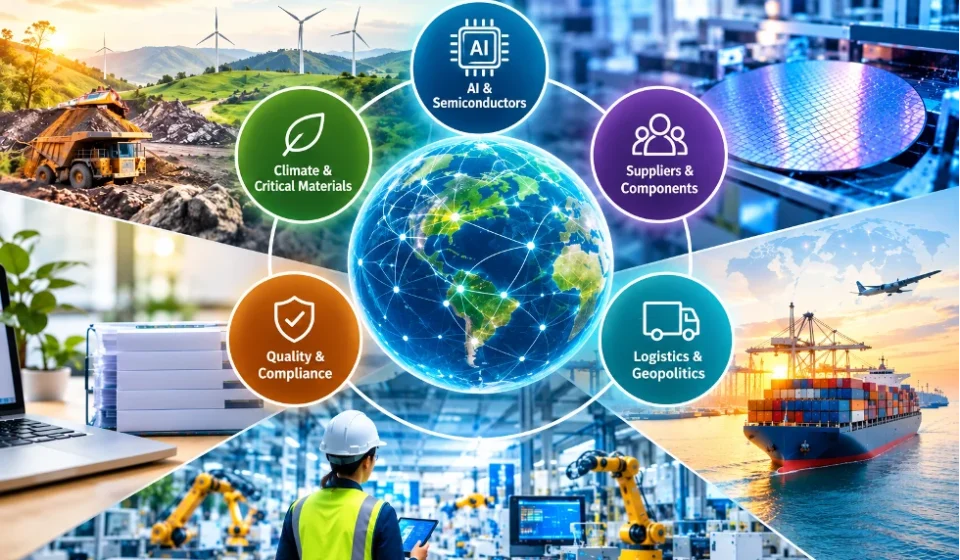
Manufacturing neither begins when a machine starts humming on the shop floor nor ends when a finished product rolls off the line and is packaged for delivery. Behind every modern manufactured good sits a vast, interconnected ecosystem of industrial designers, systems engineers, raw material and component suppliers, procurement strategists, quality professionals, technology providers, logistics networks, regulatory specialists, and end-user customers. The factory floor is merely the final assembly point for a global web of dependencies.
That foundational ecosystem is changing at an unprecedented pace. Artificial Intelligence (AI) is aggressively reshaping industrial operations, surging semiconductor demand is creating novel technological dependencies, shifting geopolitical fault lines are dictating sourcing strategies, extreme weather events are continually testing the limits of factories and supply routes, and regulatory mandates and environmental expectations are in a state of perpetual flux.
In this hyper-dynamic landscape, organizations can no longer rely solely on operational efficiency. The defining challenge of modern industry is figuring out how to build manufacturing ecosystems that can continuously sense change, adapt at a moment’s notice, and persistently deliver value when underlying business assumptions fracture.
As industries observe Manufacturing Day 2026 (MFG Day) on Friday, October 2—an initiative spearheaded by the Manufacturing Institute (the workforce development and education affiliate of the National Association of Manufacturers) designed to showcase modern industrial careers to students, educators, and communities—this existential question takes center stage [1]. The significance of manufacturing now extends far beyond mere production efficiency; it is about binding people, technology, data, suppliers, and decisions together into a cohesive, resilient value chain.
The Main Facts: Manufacturing as a Resilience Challenge
For decades, the gospel of manufacturing was absolute efficiency: optimized cost structures, consolidated supplier bases, lean inventories, and hyper-specialized production networks.

While these models generated immense economic value and fueled the engines of international trade, they also baked systemic vulnerabilities into the global economy. When a disruption strikes a critical semiconductor supplier, a rare mineral extraction site, a major shipping corridor, or an energy source, the shockwaves propagate rapidly across industries and continents. An efficient production process remains inherently fragile if its vital inputs rely on a handful of exposed, single-source nodes.
Consequently, operational resilience is no longer defined merely by whether a single plant can keep running during a crisis. True resilience measures whether an enterprise can spot emerging risks, comprehend complex dependencies, evaluate viable alternatives, and execute decisions before a disruption becomes an enterprise-threatening crisis.
Consider a disruption occurring several tiers upstream in the supply chain. While raw material availability is the immediate concern, qualifying an alternative component often requires exhaustive engineering validation, customer sign-offs, regulatory reviews, quality checks, and production line reconfigurations. Furthermore, switching to a new supplier can introduce entirely different geographic, logistical, and sub-tier risks.

The primary hurdle is rarely just finding another vendor. The true challenge is knowing whether that alternative can seamlessly support the product, the manufacturing process, regulatory compliance, and customer expectations. Resilience has officially evolved from a contingency plan into a core operating capability.
Chronology of Disruption: Geopolitical, Environmental, and Technological Flashpoints (2025–2026)
To understand how modern supply chains face pressure, one must look at a timeline of compounding global disruptions throughout 2025 and 2026:
- July 10, 2025: The U.S. Department of Defense enters a strategic agreement to invest $400 million in preferred equity in MP Materials, securing a critical domestic footing in rare-earth magnet supply chains [7].
- January 15, 2026: The World Economic Forum’s Global Lighthouse Network recognizes 23 new manufacturing sites and launches Lumina, an AI-powered industrial intelligence platform built on data from over 1,000 industrial transformations [9].
- February 26, 2026: MP Materials selects Northlake, Texas, as the site for its massive "10X" rare-earth magnet manufacturing campus, committing over $1.25 billion in private investment with commissioning slated for 2028 [8].
- February 28, 2026: Outbreak of conflict triggers a severe security crisis in the Strait of Hormuz, heavily restricting commercial vessel transit through a maritime artery that historically handles up to 140 ships daily and carries roughly one-fifth of global oil and LNG supplies [2].
- June 22, 2026: China’s Ministry of Commerce adds 10 U.S. entities—including critical mineral players MP Materials and USA Rare Earth—to its export-control management list [6]. Simultaneously, the WEF Global Lighthouse Network inducts 16 new sites, proving that AI is rapidly transitioning from isolated pilots into a core operating capability [10].
- July 20, 2026: The European Commission officially launches the Digital Product Passport (DPP) Registry and testing environment under the Ecodesign for Sustainable Products Regulation (ESPR), setting the stage for mandatory compliance rules beginning with batteries in February 2027 [11].
- August 12, 2026: The EU Packaging and Packaging Waste Regulation takes formal effect, enforcing a phased framework for harmonization, composition, recyclability, and waste reduction [12].
- August 14, 2026: Water levels at Kaub, Germany, plunge below 10 centimeters, setting a historic low on the Rhine River and throwing European bulk chemical and energy logistics into turmoil [4].
- September 17, 2026: Reuters reports that only three commercial vessels transited the Strait of Hormuz the previous day, underscoring persistent maritime blockades [2]. On the same day, Applied Materials announces a landmark $5 billion investment in India over the next decade at the SEMICON India 2026 conference, which convenes over 600 companies from 52 countries [3].
Supporting Data: The Anatomy of Global Vulnerabilities
The real-world impacts of these milestones are underpinned by striking quantitative realities across geopolitics, technology, and environmental exposure:

1. Maritime Bottlenecks and Geopolitical Risk
The ongoing crisis in the Strait of Hormuz highlights how localized conflicts ripple into global manufacturing. Prior to the conflict on February 28, 2026, the Strait accommodated 125 to 140 commercial vessels daily. By mid-September 2026, daily transit volumes plummeted to single digits (e.g., three vessels on September 16), severely endangering global energy markets, freight rates, working capital, and production planning [2].
2. Semiconductor Shifts and AI-Driven Dependencies
AI infrastructure demands have exponentially increased pressure on semiconductor capacity, particularly for high-bandwidth memory and advanced processors. Simultaneously, developing markets are attempting to capture market share. India projects its semiconductor consumption will skyrocket to $110 billion by 2030 (up from $45–$50 billion in 2025). Backed by over $21 billion in government incentives across 12 approved projects, India’s ambitions face hurdles; notably, large-scale fabrication facilities like the planned Tata Electronics project in Gujarat have encountered nearly two years of delays, reminding the industry that semiconductor ecosystems require complex, time-intensive networks of equipment, materials, and skilled labor [3].
3. Critical Mineral Dominance
Rare-earth elements remain a prime example of systemic single-source dependency. According to the International Energy Agency’s April 2026 report, China accounted for approximately 60% of global mined production of magnet rare earths, 91% of global refined output, and 94% of global sintered permanent magnet production in 2024 [5]. This extreme market concentration leaves downstream Western manufacturers intensely vulnerable to trade policy shifts, such as China’s June 2026 export-control restrictions targeting U.S. entities [6].

4. Climate and Logistical Exposure
Environmental hazards continue to disrupt industrial operations miles away from physical production sites. The historic drop of the Rhine River water levels below 10 cm at Kaub on August 14, 2026, crippled European bulk chemical transportation [4]. Industrial giants like BASF were forced to pivot toward specialized low-water vessels and ramp up road and rail alternatives to avert widespread force majeure declarations, proving that climate risk is synonymous with supply chain risk.
Official Responses and Strategic Pivots
Faced with compounding structural vulnerabilities, industry leaders, governments, and international bodies are enacting aggressive policy and operational changes:
- Government Interventions: Western governments are deploying industrial policy to secure strategic domestic capacities. The U.S. Department of Defense’s $400 million equity investment in MP Materials and the subsequent development of the $1.25 billion Northlake, Texas, rare-earth magnet facility (set for 2028 commissioning) are prime examples of rebuilding domestic value chains from extraction to recycling [7, 8].
- Regulatory Frameworks in Europe: The European Commission is aggressively enforcing data transparency and sustainability standards. The launch of the Digital Product Passport (DPP) Registry on July 20, 2026, and the enactment of the EU Packaging and Packaging Waste Regulation on August 12, 2026, demonstrate that compliance can no longer be handled as a retroactive paperwork exercise [11, 12]. Regulatory mandates now directly dictate product design, material choices, and digital traceability.
- Industrial Collaboration: Platforms like the World Economic Forum’s Global Lighthouse Network—which expanded to 238 sites by mid-2026—are actively guiding manufacturers away from isolated technological experiments. By deploying AI platforms like Lumina, these industrial leaders are proving that machine intelligence must be harnessed to optimize end-to-end planning, sourcing, and logistics [9, 10].
Implications: The Five Pillars of an Adaptive Manufacturing Model
To thrive amidst geopolitical friction, climate volatility, and regulatory shifts, manufacturers must transition from reactive firefighting to proactive adaptability. Organizations must ask a fundamental question regarding inventory and planning: “How much decision time do we need?”

Strategic inventory and digital visibility should not be deployed merely to buffer against inefficiency, but to buy the organization enough time to qualify alternative suppliers, redesign components, or re-route logistics before a disruption cripples production.
Achieving this level of enterprise resilience requires mastering five core capabilities:
- Intelligence: Leveraging AI, advanced analytics, and machine learning to detect patterns, forecast demand, and identify vulnerabilities across the extended value chain rather than just monitoring the factory floor.
- Visibility: Maintaining granular, real-time mapping of products, raw materials, tier-one and sub-tier suppliers, logistics routes, and regulatory obligations. Visibility is the absolute prerequisite for spotting exposure.
- Optionality: Cultivating pre-vetted alternative suppliers, secondary components, substitute materials, and flexible logistics corridors before an emergency strikes.
- Adaptability: Establishing cross-functional operating models where engineering, procurement, quality assurance, compliance, and leadership can rapidly collaborate to re-source, substitute, or redesign products under pressure.
- Trust: Ensuring that product data, bills of materials, regulatory evidence, and AI-driven insights are accurate, secure, and rigorously governed. AI may be the engine of modern industry, but trusted data is its fuel.
Conclusion
Manufacturing Day 2026 serves as a powerful reminder that modern industrial careers encompass far more than traditional assembly lines. Today’s ecosystem relies on materials scientists, design engineers, procurement strategists, compliance experts, cybersecurity specialists, sustainability officers, data architects, and data-driven technicians.

No organization can completely insulate itself from geopolitical conflicts, semiconductor crunches, extreme weather events, or sudden regulatory shifts. However, enterprises can choose to build the structural capacity to sense change early and respond decisively.
Ultimately, the future of manufacturing will not belong solely to the largest factories, the highest levels of automation, or the lowest cost centers. It will belong to those who successfully connect people, technology, data, products, and sustainability across the entire value chain—transforming manufacturing from a rigid exercise in efficiency into a resilient, intelligent, and adaptable engine for modern life.
References
[1] Manufacturing Institute, MFG Day 2026. Available: https://mfgday.com/
[2] Reuters, "Number of ships transiting Strait of Hormuz falls to three on Wednesday, data shows," September 17, 2026. Available: Reuters
[3] Reuters, "Applied Materials to invest $5 billion in India as Modi’s flagship chip event kicks off," September 17, 2026. Available: Reuters
[4] S&P Global, "The Rhine drops below 10 cm at Kaub, disrupting European oil logistics," August 14, 2026. Available: S&P Global
[5] International Energy Agency, Rare Earth Elements: Pathways to Secure and Diversified Supply Chains, April 2026. Available: IEA
[6] China Ministry of Commerce, Export-control measures concerning 10 U.S. entities, June 22, 2026. Available: MOFCOM
[7] Reuters, MP Materials and U.S. Department of Defense investment partnership, July 10, 2025. Available: Reuters
[8] MP Materials, Northlake, Texas "10X" rare-earth magnet manufacturing campus announcement, February 26, 2026. Available: MP Materials Investors
[9] World Economic Forum, Global Lighthouse Network recognizes 23 new sites and launches Lumina AI platform, January 15, 2026. Available: WEF
[10] World Economic Forum, Global Lighthouse Network update on AI rewiring manufacturing, June 22, 2026. Available: WEF
[11] European Commission, "The Digital Product Passport Registry is now live," July 20, 2026. Available: EU Single Market Economy
[12] European Commission, "New packaging rules for less waste and easier recycling," August 12, 2026. Available: European Commission