

Breaking the Barrier: ANYbotics Launches ANYmal X, the World’s First Ex-Proof Legged Inspection Robot

In a landmark achievement for industrial robotics, Zurich-based ANYbotics AG has officially commenced the delivery of the ANYmal X, a revolutionary quadrupedal robot specifically engineered for deployment in explosive and hazardous atmospheres. Long considered the "holy grail" of industrial automation, this development marks a paradigm shift in how high-risk sectors—most notably oil, gas, and chemical manufacturing—manage site safety, maintenance, and operational continuity.
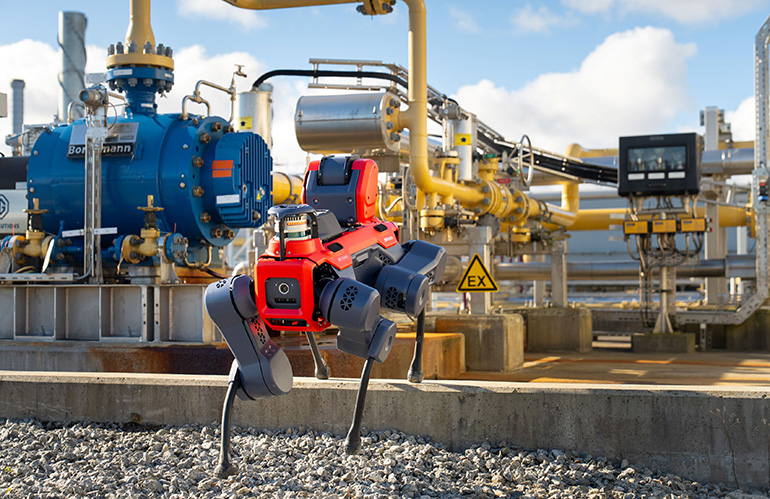
For decades, human operators have been the sole eyes and ears inside hazardous zones, forced to navigate dangerous environments while burdened with heavy personal protective equipment (PPE) and handheld gas detectors. The introduction of ANYmal X, which boasts formal ATEX and IECEx certification, promises to remove humans from these high-risk scenarios, replacing manual patrols with autonomous, intelligent, and relentless data collection.
The Genesis: A Four-Year Engineering Odyssey
The journey to the ANYmal X began four years ago, born from a need to bridge the gap between human agility and robotic safety. ANYbotics, a spin-out from the world-renowned ETH Zurich, spent years refining the mechanical and software architecture required to survive in environments where a single spark could prove catastrophic.
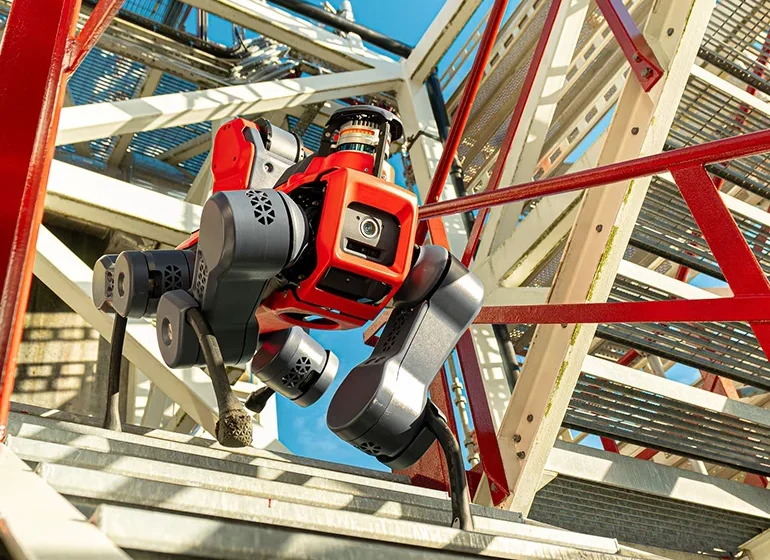
"Many experts thought a legged robot could never be made safe for explosive atmospheres," noted Péter Fankhauser, co-founder and CEO of ANYbotics. The engineering challenge was twofold: creating a machine capable of navigating complex, human-centric architecture (such as vertical ladders, steep stairs, and narrow cat-walks) while simultaneously ensuring that no electrical or thermal component could act as an ignition source.
The company filed over 10 patents during the development process, eventually securing the necessary certifications to operate in zones where flammable gases and dust are present. The result is a machine that does not merely mimic human movement but transcends it in terms of precision and data consistency.
The High Cost of Silence: Why Inspection Matters
The economic imperative behind the ANYmal X is staggering. The global oil, gas, and chemical sector, a market valued at approximately $102 billion, is plagued by two primary cost drivers: the exorbitant expense of deploying highly trained personnel for routine inspections and the massive financial impact of unplanned downtime.
Industry data indicates that undetected equipment failures cost the world’s 500 largest companies roughly $1.4 trillion annually. Within the oil and gas sector specifically, a single hour of unplanned downtime can result in losses reaching $500,000. These failures often begin as subtle anomalies—a slightly overheating compressor, a faint gas leak, or a vibrating valve—that are easily missed during infrequent manual rounds.
Beyond the financial ledger, the human cost is even more severe. According to the National Institute for Occupational Safety and Health (NIOSH), U.S. extraction workers face a fatality rate seven times the national average. By automating the inspection of hazardous "hot zones," ANYmal X directly addresses these systemic risks, shifting the role of the human operator from a "field scout" to a "data analyst."
Engineering for Explosive Environments: The Science of Safety
Certifying a robot for hazardous environments is notoriously difficult. Unlike fixed industrial equipment, which can be housed in heavy, explosion-proof enclosures or designed with limited energy circuits, a legged robot requires high-power actuators, significant battery capacity, and exposed sensors for navigation.
To reconcile these requirements, ANYbotics re-engineered the robot from the ground up:
- Sealed Architecture: Sensitive electronics and the AI compute core are housed in nitrogen-purged, hermetically sealed chambers to ensure no flammable gases can reach electrical components.
- Thermal Management: The robot utilizes automatic cutoffs to monitor temperature, preventing any component from reaching an ignition threshold.
- Grounding and Insulation: All metallic components are insulated by non-metallic outer shells, and the robot’s feet are designed to provide constant grounding, preventing the buildup of static electricity.
- Flameproof Casings: Each of the 12 leg actuators—the muscles of the robot—is protected by specialized flameproof housing.
- Intrinsically Safe Connections: Charging and data transmission points utilize energy barriers, ensuring that the robot remains "cool" even during high-intensity data transfers.
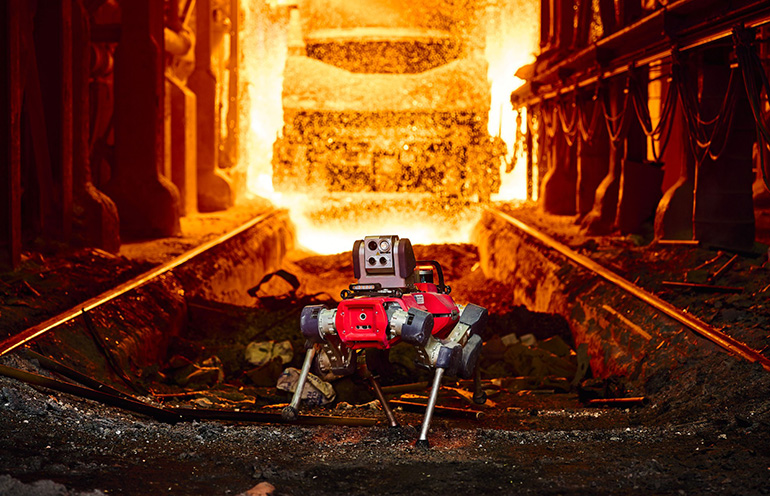
Furthermore, the robot’s onboard software performs continuous self-diagnostics. Before, during, and after every mission, the system validates the integrity of its protective measures against vibrations, solar radiation, salt mist, and mechanical shock.
Integration: More Than Just a Robot
ANYbotics emphasizes that the hardware is only the "entry ticket." To provide actual value to facility managers, the robot operates as part of the Shift software platform. This system acts as the central nervous system for plant operations, scheduling missions, organizing findings by specific asset, and automatically generating maintenance work orders in enterprise software like SAP, Yokogawa, or SLB.
"Plants run on process data from their control systems and business data from their ERP," explains Thierry Obédé, Chief Revenue Officer at ANYbotics. "The third source—what operators see, hear, and measure—has always been manual. ANYmal X now captures it autonomously, even inside hazardous areas, and we stand behind the whole chain."
This integration creates a "digital twin" of the facility. By capturing consistent, structured, and repeatable data, the system allows for predictive maintenance, where the "health" of a machine is tracked over time, allowing for interventions weeks or months before a failure occurs.
Industry Validation: The Early Access Program
Before its full-scale market release, the ANYmal X underwent rigorous real-world testing. Since 2023, industry giants including BP, Equinor, Shell, PETRONAS, Petrobras, BASF, and SLB have put the robot through its paces in both onshore and offshore environments.
These companies participated in an Early Access Program, providing critical feedback that allowed ANYbotics to refine the platform for extreme industrial conditions. The ability of the robot to navigate without the need for facility modifications—climbing stairs and maneuvering through tight walkways—was cited as a key differentiator.
The robot’s sensor suite includes thermal, visual, acoustic, and gas detection capabilities. This allows it to "smell" leaks, "hear" bearing failures in rotating equipment, and "see" thermal hotspots that are invisible to the naked eye.
Future Implications: The Autonomous Facility
The launch of ANYmal X signals the beginning of a broader trend toward the "autonomous facility." As labor shortages in technical fields persist and the demand for higher safety standards increases, the deployment of intelligent, mobile robotics is moving from the realm of "innovation projects" to "operational necessity."

The implications are far-reaching:
- Workforce Augmentation: By removing the need for workers to enter hazardous zones, companies can redeploy staff to higher-value roles, such as remote monitoring and complex system engineering.
- Data-Driven Sustainability: Better leak detection and equipment monitoring lead to lower emissions and reduced resource wastage, helping energy companies meet their environmental, social, and governance (ESG) targets.
- Standardization of Safety: With AI-driven inspections, safety becomes a consistent, measurable metric rather than a variable based on human fatigue or oversight.
As ANYbotics prepares to showcase the platform at the ADIPEC 2026 conference alongside partners like SLB and Kuwait Oil Co., the message to the industry is clear: the era of the "unreachable" hazardous zone is over.
A New Benchmark for Robotics
ANYbotics, now backed by over $150 million in funding from elite European and Silicon Valley investors, has grown to a team of 200 experts across Zurich, San Francisco, and Barcelona. Their success with ANYmal X proves that even the most daunting engineering constraints can be overcome with rigorous, physics-based design and a deep understanding of industrial requirements.
As the units begin to ship, the industrial world will be watching closely. If the performance in the early access programs is any indicator, the oil, gas, and chemical sectors are about to see a significant uptick in operational efficiency. For the engineers at ANYbotics, however, the goal remains the same as it was four years ago: to ensure that the most dangerous jobs in the world are never performed by a human again.
By successfully marrying high-speed autonomous mobility with stringent safety protocols, ANYbotics has set a new gold standard. Whether it is a deep-sea oil platform or a vast chemical processing plant, the future of inspection is no longer just on two feet—it’s on four, and it never needs a break.