



Breaking the Bottleneck: How Design Automation is Revolutionizing Quality Inspection

In the modern manufacturing landscape, the quality department is often the unsung hero of the production line. It is the final gatekeeper, ensuring that every component meets rigorous specifications before reaching the customer. However, these teams frequently operate under the shadow of a persistent, systemic inefficiency: the "tooling gap."
For decades, industrial partners have grappled with a recurring pattern: the fixtures themselves are rarely the root cause of quality failures—the convoluted design process behind them is. While custom gages, holding fixtures, and positioning jigs are fundamental to repeatable inspection, the traditional path to acquiring them is fraught with friction. By modernizing how these tools are conceived and created, the industry is witnessing a shift that promises to transform quality control from a reactive hurdle into a proactive, agile advantage.
The Traditional Bottleneck: CAD, Queues, and Compromise
The traditional workflow for creating custom inspection tooling is a relic of an era where design expertise was siloed. When a quality engineer identifies a need for a specific holding fixture, the request rarely stays within their department. Instead, it enters an engineering queue.
The Chronology of a Traditional Fixture Request
- Identification: A quality engineer identifies a need for a repeatable measurement jig.
- The Hand-off: A request is drafted and submitted to the design or engineering department.
- The Queue: The request waits for an available designer who has the necessary CAD proficiency.
- Interpretation: The designer must translate the engineer’s requirements into a 3D model, often requiring multiple back-and-forth emails or meetings to clarify dimensions and tolerances.
- Validation & Prep: The CAD file is finalized, converted to a manufacturing format, and sent to the shop floor.
- Production: A machinist or technician prepares the tool, often using subtractive methods like CNC machining.
While none of these individual steps are inherently difficult, the cumulative effect is stagnation. This process can consume days or even weeks. For a production floor that moves at the speed of modern logistics, such delays are unacceptable.
The consequences are predictable. When fixtures arrive late, quality teams are forced to improvise. Sometimes, they settle for "good enough" simplified tools that lack the necessary precision. In more severe cases, they abandon custom tooling altogether, reverting to manual handling—a practice that introduces human error, increases variance, and ultimately compromises the integrity of the inspection process.
Design Automation: Moving from Drawing to Configuring
The solution to this bottleneck lies in a fundamental shift in software architecture: design automation. Rather than treating fixture design as a bespoke CAD task, design automation platforms capture the engineering logic within the software itself.
In this new paradigm, the user is no longer required to draw geometry. Instead, they act as a "configurator." By uploading a part model, the quality engineer can define functional inputs—such as contact surfaces, clamping points, and specific tolerances—within an intuitive interface. The software then leverages these parameters to generate the underlying geometry automatically, exporting a print-ready file in minutes rather than hours.
This democratization of design means that the people who best understand the inspection requirement—the quality engineers themselves—can now be the ones to execute the solution.
The Ecosystem of Efficiency: Beyond the Fixture
While holding fixtures are the most obvious candidates for automation, the broader inspection environment is rife with similar inefficiencies. Every shadow board that organizes gages, every clamping jaw that holds a part during metrology, and every logistics tray that protects delicate components requires a degree of customization.
Platforms like the Additive App Suite have emerged to tackle this wider ecosystem. By treating shadow boards, assembly trays, and specialized organizers as configurable workflows, these systems remove the "design friction" that once kept these tools in the realm of specialized CAD labor.
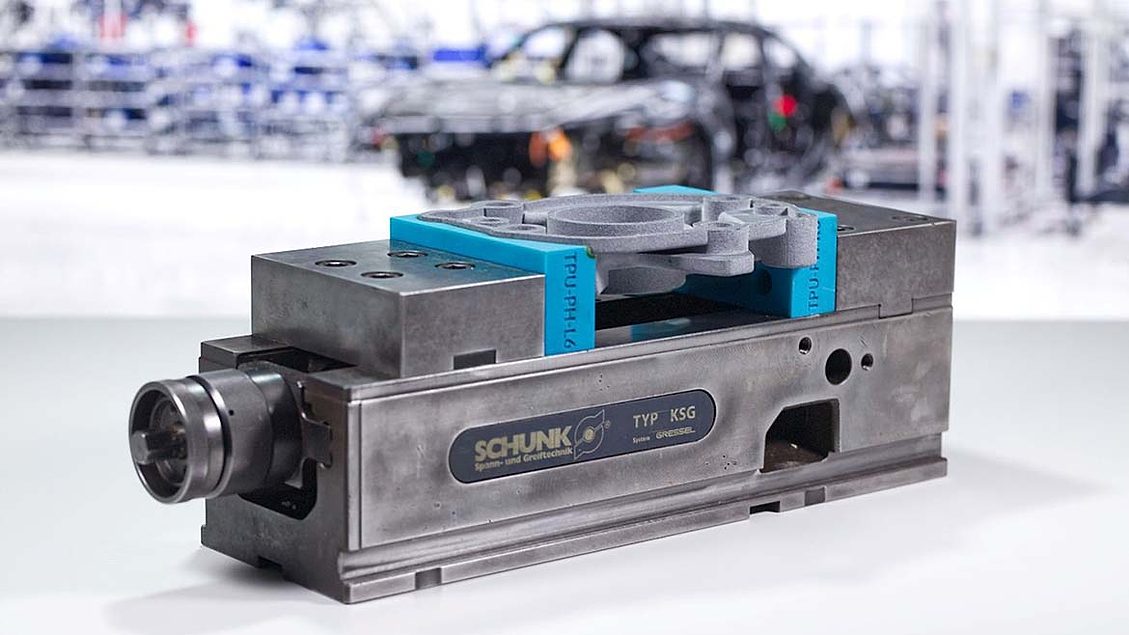
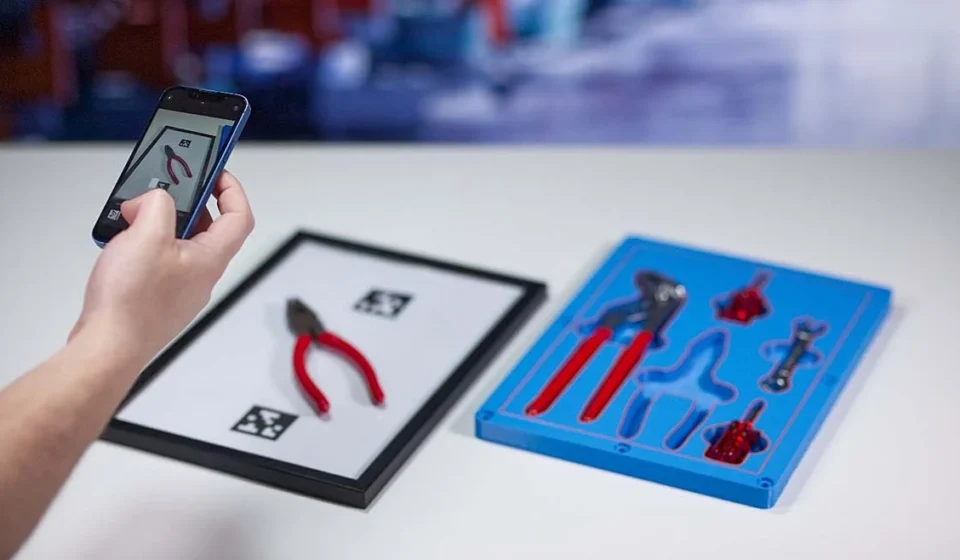
For instance, "Photo-to-Outline" technologies now allow teams to take a simple photograph of a set of instruments and automatically generate a custom-fitted cutout for a shadow board. What was once an afternoon of measuring and manual tracing becomes a five-minute digital process. This enables quality teams to maintain 5S standards on the shop floor with minimal effort, ensuring that every tool is exactly where it needs to be, exactly when it is needed.
The Additive Manufacturing Synergy
Design automation would be far less potent without the advancements in additive manufacturing (AM). Traditional manufacturing, such as CNC machining, often requires setup times and material waste that make "one-off" production expensive and slow.
Additive manufacturing acts as the perfect partner for automated design. Once a fixture file is generated, it can be sent directly to a polymer 3D printer. For the vast majority of inspection tools, high-stress structural loads are not the primary concern; accuracy, repeatability, and geometric fit are. Polymer-based additive manufacturing provides the ideal balance of material properties to meet these needs at a fraction of the cost and time of traditional methods.
Implications for Iteration and R&D
The marriage of automation and AM allows for a "fail-fast" culture in the quality lab. If a fixture does not perform as expected, or if the part design evolves slightly, the quality engineer can adjust the parameters in the software and print a new version by the next shift. This iterative capability was previously unthinkable in environments reliant on external machine shops.
Official Perspectives: The Shifting Focus of Industry Leaders
Industry experts and technology providers are increasingly emphasizing that the "hardware-first" mindset of the early 2000s is giving way to a "software-first" reality.
"For years, the industry was obsessed with the printer—the build volume, the laser speed, the material variety," says one lead software developer in the additive space. "But the real hurdle to adoption wasn’t the machine. It was the design time. If you have a $500,000 printer but it takes your best engineer three days to design a simple jig for it, you aren’t actually saving money. The value proposition of additive manufacturing only truly unlocks when you make the design process as fast as the printing process."
This sentiment is echoed by production managers who note that empowering the shop floor staff with intuitive design tools has boosted morale and efficiency. By removing the dependency on outside engineering resources, quality departments are no longer "waiting for the solution"—they are creating it.
The Future of Responsive Quality Control
The transition toward automated design and additive production is not merely a technical upgrade; it is a fundamental change in how quality departments operate.
- Responsiveness: Inspection teams can now adapt to new product introductions or engineering change orders (ECOs) in real-time.
- Standardization: Because designs are stored as parameters, it is easy to standardize a specific fixture type across multiple global manufacturing sites. If a plant in Germany develops a perfect clamping solution, that "logic" can be shared instantly with a plant in Mexico, ensuring consistent quality protocols worldwide.
- Accessibility: The barrier to entry for custom tooling has been shattered. Junior quality technicians can now produce tools that would have previously required a senior design engineer’s sign-off.
Conclusion
As we look toward the future of manufacturing, the integration of design automation and additive manufacturing will be the defining feature of the "agile factory." By eliminating the design bottleneck, we do more than just produce fixtures faster; we liberate the quality department from the constraints of legacy workflows.
When the friction of tooling creation disappears, inspection setups become more robust, measurement processes become more standardized, and the overall responsiveness of the production line increases. We are moving toward a manufacturing ecosystem where the quality department is no longer a bottleneck in the workflow, but rather the catalyst for faster, more reliable, and more flexible production. The era of waiting for a fixture is coming to an end; the era of instant, automated quality control has begun.