





The Great American Industrial Revival: Assessing the Talent Gap in the New Manufacturing Era

The American industrial landscape is undergoing a transformation of historic proportions. According to a comprehensive new data report titled The Rise of U.S. Manufacturing, released by MISUMI Americas, the sector has surged to record-breaking levels of productivity and investment. Yet, even as the United States solidifies its position as a global manufacturing powerhouse, the industry faces an existential threat: a widening talent gap that threatens to stifle the momentum of the current economic cycle.
The data, synthesized from the Bureau of Labor Statistics (BLS), the Bureau of Economic Analysis (BEA), and other federal authorities, paints a portrait of a sector that has effectively become the eighth-largest economy in the world, if measured as a standalone entity. However, as capital pours into semiconductor fabs and electric vehicle (EV) battery plants, the industry is bumping into a constraint that money alone cannot resolve—a labor shortage that experts warn could leave 1.9 million jobs unfilled by 2033.
A Chronology of Industrial Resurgence
The current manufacturing boom did not happen overnight; it is the culmination of years of legislative effort, global supply chain shifts, and significant private sector commitment.
The Foundation (2020–2021)
The trajectory began to shift during the pandemic era, as global supply chain disruptions exposed the vulnerabilities of lean, overseas-dependent manufacturing. Following the disruptions of 2020, policymakers began a pivot toward "reshoring," emphasizing national security and economic independence. By 2021, factory construction spending sat at approximately $81.9 billion, a baseline figure that would soon be eclipsed by massive policy-driven investments.
The Acceleration (2022–2024)
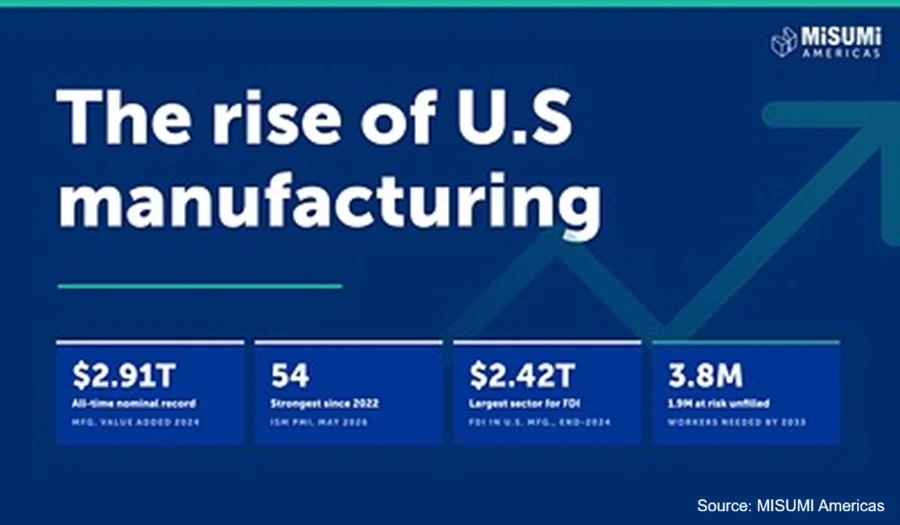
The passage of landmark legislation—specifically the CHIPS and Science Act and the Inflation Reduction Act—served as a catalyst. In 2024, U.S. manufacturing value-added reached an all-time nominal record of $2.91 trillion. Simultaneously, factory construction spending tripled from its 2021 levels, peaking at $235.6 billion in 2024. This period marked the most aggressive infusion of capital into domestic production in modern history.
The Current Landscape (2025–2026)
As of May 2026, the industry is showing clear signs of sustained expansion. The ISM Manufacturing PMI reached 54, the strongest reading since May 2022. This represents a critical reversal from the sluggish growth seen throughout 2025, where the index hovered below the 50-point contraction threshold. With new orders, production, and backlogs all trending upward, the manufacturing sector has successfully transitioned from a post-pandemic recovery phase into a period of proactive, high-tech expansion.
Data-Driven Insights: The Pillars of Growth
The Rise of U.S. Manufacturing report identifies several key metrics that define the health and scale of this industrial renaissance.
- Foreign Direct Investment (FDI): Foreign companies have committed $2.42 trillion to U.S. manufacturing, representing over 42% of all inbound FDI in the United States. Japan, Germany, and Canada lead this investment, with Japan alone accounting for over $819 billion. This underscores the global consensus that the U.S. is the premier destination for high-tech production.
- The Technology Shift: The nature of the jobs being created has evolved. In 2024, 88% of all announced manufacturing job growth was concentrated in high or medium-high technology sectors, including semiconductors, advanced electronics, and automotive manufacturing.
- The Workforce Deficit: Despite the success in attracting capital, the human capital side of the ledger is strained. The industry requires 3.8 million additional workers by 2033. Approximately 2.8 million of these openings are driven by an aging workforce nearing retirement, while the remainder represents growth from new infrastructure and tech projects.
The Proposed Solution: H.R. 9097
Recognizing that domestic training pipelines, while improving, cannot scale fast enough to meet the 2033 demand, MISUMI Americas has thrown its support behind H.R. 9097, the American Manufacturing Revitalization Exchange Program Act.
Introduced by Rep. Bill Huizenga (R-MI), this bipartisan legislation aims to bridge the expertise gap by leveraging international partnerships. The bill proposes a structured exchange program that would send American workers to allied nations—specifically those with established, world-class manufacturing ecosystems like Japan, Germany, and South Korea—for hands-on training.
The Mechanics of the Exchange
Under the proposed act, students and workers would be placed in 6-to-12-month training programs in specialized fields such as robotics, semiconductor fabrication, and precision engineering. Upon completion, participants would receive a full stipend and industry-recognized credentials, bringing advanced technical expertise back to the U.S. floor.
"Having a strong manufacturing sector is critical to our economy, national security, and ability to compete globally," Congressman Huizenga stated during the bill’s introduction. "This bipartisan legislation will help reshore American manufacturing, equip American workers with in-demand skills, and rebuild our nation’s middle class."
Implications: The Looming Talent Constraint
The primary risk to the current manufacturing boom is not a lack of interest, but a lack of specialized, advanced skills. While enrollment at high-vocational community colleges has risen by 20% since the spring of 2020, and undergraduate certificate programs have seen four consecutive years of growth, the raw numbers remain insufficient. Total enrollment at these institutions currently sits well under one million—a fraction of the millions of workers needed over the next decade.
Industry Perspective
Dave Evans, President and CEO of MISUMI Americas and CEO of Fictiv, emphasizes that the industry has reached a "capital-sufficient, talent-constrained" phase.
"The investment case for American manufacturing has never been stronger," Evans said. "What we see with our customers every day is that the next constraint isn’t capital. It’s having enough people with the right advanced skills to run these new facilities at full capacity. H.R. 9097 builds directly on the momentum of our students choosing skilled trades by sending them to learn from the countries that have spent decades perfecting advanced manufacturing training."
A Broad Coalition of Support
The urgency of this talent crisis is reflected in the diverse coalition supporting H.R. 9097. The bill has garnered backing from the National Association of Manufacturers, the Manufacturing Institute, United Steelworkers, IEEE-USA, and major global corporations like BMW Group. This level of cross-industry and cross-union support signals that the manufacturing community views the talent shortage as a shared challenge that requires a unified, policy-driven response.
Looking Ahead: Building the Workforce of Tomorrow
As the U.S. economy navigates the remainder of the decade, the success of the manufacturing sector will be defined by its ability to integrate the "old guard" of expertise with a new generation of technical talent.
The data suggests that the "reshoring" movement is not merely a temporary trend but a fundamental shift in the global industrial order. With over 2 million jobs announced since 2010 and 1.7 million already filled, the momentum is undeniable. However, the path to 2033 remains steep.
If the U.S. is to maintain its competitive edge, the focus must shift from simply announcing new facilities to ensuring those facilities are operated by a world-class, highly trained workforce. Whether through vocational reform, increased community college enrollment, or the implementation of international exchange programs like H.R. 9097, the mandate for the next decade is clear: the United States must cultivate a talent pipeline that is as sophisticated as the technology it intends to produce.
For industry leaders and policymakers alike, the lesson of the 2026 data is that while the U.S. has successfully built the stage, the performance of the coming decade depends entirely on who is standing in the wings, ready to take their place on the factory floor.