




Powering the Future: Navigating the Complex Transition to 48 V Automotive Architectures

The global automotive landscape is currently undergoing its most significant structural shift in over a century. As the industry pivots toward Software-Defined Vehicles (SDVs) and increasingly sophisticated Advanced Driver-Assistance Systems (ADAS), the demand for onboard electrical power has surged exponentially. To meet these requirements, the industry is rapidly transitioning from the long-standing 12 V power standard to 48 V systems.
Nisshinbo Micro Devices, a veteran in the power management semiconductor sector, is at the forefront of this evolution. By leveraging decades of expertise in 12 V power supply design, the company is now positioning itself as a strategic partner for OEMs and Tier 1 suppliers navigating the technical hurdles of high-voltage integration.
The Mandate for 48 V Systems: Efficiency and Weight Reduction
The primary driver behind the shift to 48 V architectures is simple physics. As power consumption increases due to high-performance computing, electrification of auxiliary systems, and active safety sensors, maintaining a 12 V system becomes increasingly inefficient.

By quadrupling the voltage to 48 V while maintaining constant power output, the required current is reduced by a factor of four. This reduction is critical for two reasons:
- Minimization of I²R Losses: Electrical current loss is directly proportional to the square of the current. Reducing current significantly mitigates power loss, leading to greater overall system efficiency.
- Harness Weight Reduction: Lower current allows for thinner wiring harnesses. In the context of modern vehicle design, where every gram of weight impacts range and fuel efficiency, the ability to shed substantial weight from the wiring harness is a transformative advantage for EV and hybrid manufacturers.
Chronology of the Transition
The movement toward higher voltages in passenger vehicles has been a slow burn that recently ignited into a full-scale industry mandate.
- 2010–2018: The Conceptual Phase: Initial discussions regarding the "48 V Mild Hybrid" began as a solution for start-stop technology and power-hungry chassis systems, such as electric power steering.
- 2019–2023: The Acceleration of SDVs: The rise of autonomous driving features and the "Software-Defined Vehicle" concept necessitated centralized computing architectures. These computers require higher, stable power rails, pushing 48 V from a "mild hybrid" novelty to a core infrastructure requirement.
- 2024–Present: The Integration Era: As of 2026, the focus has shifted toward solving the specific engineering challenges of 48 V, including thermal management, electromagnetic interference (EMI), and the coexistence of 48 V sub-systems with 400 V/800 V traction batteries.
Thermal Challenges and the Rise of DC/DC Converters
A significant pain point in the transition to 48 V is the thermal limitation of traditional components. Historically, Low-Dropout (LDO) regulators have been the gold standard for voltage conversion due to their low noise profile. However, LDOs dissipate the difference between input and output voltage as heat.

In a 12 V system, this thermal dissipation is manageable. In a 48 V system, however, the input-to-output voltage differential is significantly higher, leading to heat generation that can quickly exceed the thermal thresholds of typical automotive components.
Nisshinbo Micro Devices has identified this as a critical inflection point. "Automakers view the current range between 20 mA and 100 mA as a significant challenge," explains Shigeki Kajitani, Automotive Business Manager at Nisshinbo Micro Devices. "While LDOs were once sufficient for microcontrollers, the thermal constraints of 48 V systems make them impractical for current requirements exceeding 20 mA. We are seeing a major industry shift toward replacing LDOs with DC/DC converters in this specific range."
However, this does not spell the end for LDOs. In secondary power supply applications—where the system steps down from 12 V to feed sensitive sensors—the demand for the low-noise characteristics of LDOs remains robust. The strategy, therefore, is not a wholesale replacement, but a more intelligent, application-specific selection of power components.

Technical Imperatives: Noise, Power, and Compactness
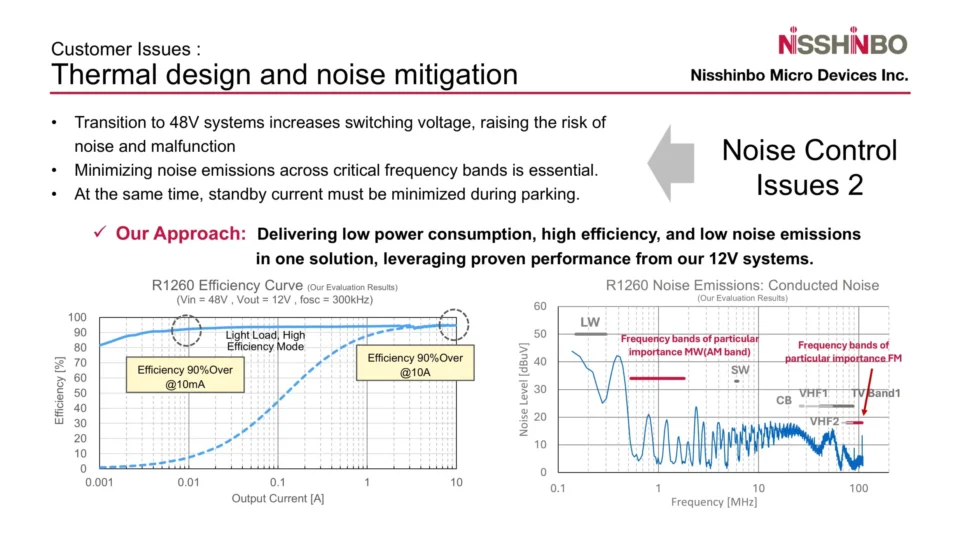
As switching frequencies increase in 48 V systems, designers face the dual challenge of electromagnetic interference (EMI) and strict standby power consumption requirements.
The Conflict of Design Trade-offs
There is a fundamental conflict in circuit design: increasing current capability usually makes noise suppression easier, but at the cost of power efficiency and size. Nisshinbo has focused its R&D on bridging this gap. Their R1525 LDO, for example, achieves high immunity (33 dBm) while maintaining a standby current of just 2.2 µA. By applying this "best-of-both-worlds" philosophy to their 48 V-rated R1560 and R1561 LDOs, the company enables designers to maintain system reliability without sacrificing efficiency.
Controlling Emissions
For switching regulators, the R1260 DC/DC controller represents the state-of-the-art. It utilizes spread-spectrum technology to minimize noise, ensuring compliance with the stringent CISPR 25 Class 5 noise standards.

"Suppressing noise to this level is not a feat achieved by an IC alone," Kajitani notes. "It requires a holistic approach—selecting the right peripheral components and optimizing the PCB layout. Our role as a partner is to provide that comprehensive support, ensuring that our customers achieve compliance efficiently."
Official Response: The "System-Level" Philosophy
Nisshinbo Micro Devices is moving beyond the role of a traditional component supplier. They are positioning themselves as a system-level consultant. Their approach to size constraints—a major issue in the densely packed power control units of modern EVs—is centered on single-chip integration.
By integrating analog, power, and digital components onto a single die, Nisshinbo creates Application-Specific Standard Products (ASSPs) and Power Management ICs (PMICs) that drastically reduce the footprint of power delivery systems.

Coexistence with High-Voltage Battery Systems
Perhaps the most complex technical hurdle is the safe coexistence of low-voltage (12/48 V) auxiliary systems with the 400 V or 800 V main traction batteries. Isolation is paramount.
Nisshinbo is actively developing isolated gate drivers and high-voltage monitor ICs. These components serve as the "bridge" between the high-voltage powertrain and the low-voltage logic systems, ensuring that even if a fault occurs in the main battery, the vehicle’s vital ECUs and safety systems remain powered and functional—a critical fail-safe requirement for modern automotive safety standards.
Strategic Implications: A Long-term Vision
The shift toward 48 V is not a temporary trend; it is the new baseline for automotive electrical engineering. Nisshinbo Micro Devices has committed to this transition with a multi-pronged strategy:

- Expanding the General-Purpose Lineup: Continuing to iterate on LDOs and operational amplifiers that meet the harsh environment requirements of the automotive sector.
- Custom Solutions: Deepening their engagement with ASICs and ASSPs to solve unique OEM problems.
- Contract Manufacturing: Leveraging their manufacturing capacity to provide stable supply chains for long-term automotive projects.
The company has set an ambitious target: increasing the proportion of its automotive business to more than 50% of its total revenue by 2035. This goal underscores their confidence in the long-term viability of the 48 V architecture.
Conclusion
The transition to 48 V power systems is an inevitable consequence of the industry’s drive toward electrification and intelligence. While the benefits of weight reduction and improved efficiency are clear, the engineering path is fraught with challenges related to heat, noise, and system complexity.
By focusing on deep technical dialogue, high-efficiency power ICs, and a commitment to system-level integration, Nisshinbo Micro Devices is providing the necessary tools to make this transition manageable for the industry. As Shigeki Kajitani observes, the movement is unstoppable, and for those who have mastered the power supply challenges of the past 12 V era, the future of 48 V presents an unprecedented opportunity to redefine the architecture of the modern vehicle.

For manufacturers looking to navigate this transition, the combination of high-voltage expertise and a collaborative design support model will be the deciding factor in the race to deliver the next generation of reliable, efficient, and sophisticated vehicles.