



BTU International Pioneers Fluxless Soldering with Advanced Formic Acid Reflow Technology for Semiconductor Packaging

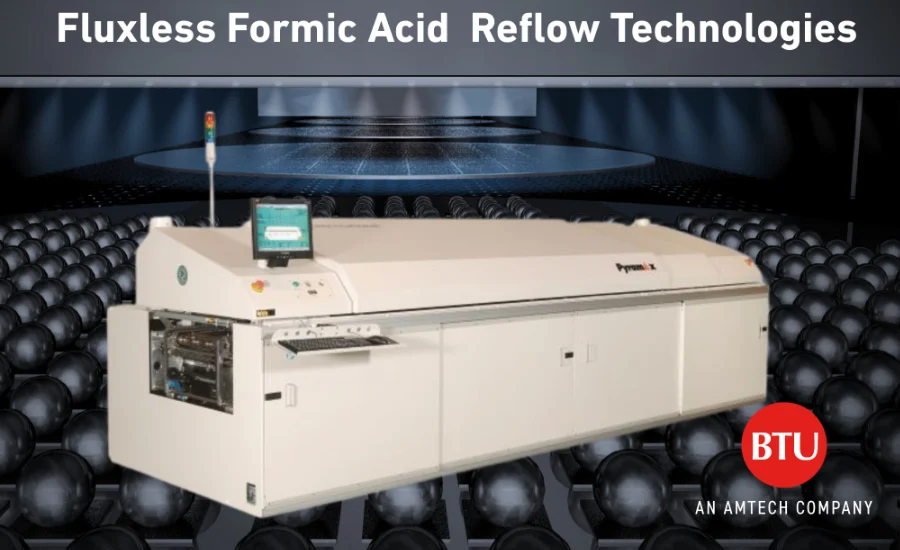
WESTFORD, Mass. — In a significant development for the microelectronics and semiconductor manufacturing sectors, BTU International has officially introduced a state-of-the-art Formic Acid Reflow capability. Engineered specifically to address the rigorous demands of advanced semiconductor packaging and high-reliability electronic assemblies, this new technology promises to redefine industry standards for fluxless soldering.
By integrating targeted formic acid delivery systems with ultra-low oxygen processing environments, BTU International aims to help manufacturers overcome persistent manufacturing challenges—such as void formation, surface oxidation, and substrate warpage—while simultaneously driving down operational costs and chemical consumption.
Main Facts: The Technology and Its Core Capabilities
At its core, BTU International’s new capability revolves around fluxless soldering, a critical manufacturing process needed as electronic components continue to shrink and performance demands escalate. Traditional soldering methods heavily rely on chemical fluxes to remove metal oxides from surfaces prior to bonding. However, flux residues can trap gases, lead to dangerous voids, create reliability hazards, and require extensive, costly post-reflow cleaning procedures.
The BTU Formic Acid Reflow system circumvents these traditional limitations through several key mechanisms:
- Targeted Chemical Delivery: Unlike legacy systems that flood the entire thermal process chamber with formic acid vapor, BTU’s proprietary design uses isolated, targeted formic acid zones. Chemistry is applied exclusively where it is needed to dissolve metal oxides on the components and substrates.
- Ultra-Low Oxygen Environment: The system consistently achieves single-digit parts-per-million (PPM) oxygen levels within the reflow chamber. This pristine environment prevents the re-oxidation of delicate metallic surfaces during the heating and cooling cycles.
- Reduced Chemical Consumption: Because the formic acid is targeted rather than blanket-distributed, overall chemical consumption is drastically reduced. This lowers material overhead and minimizes exhaust abatement requirements.
- Platform Versatility & TrueFlat Compatibility: The new capability is fully compatible with multiple BTU reflow platforms. Crucially, it integrates seamlessly with BTU’s proprietary TrueFlat technology, which is engineered to actively control and mitigate substrate warpage during high-temperature thermal processing.
- Targeted Industry Applications: The technology is tailored for high-end applications, including advanced packaging architectures, flip-chip assemblies, power semiconductor devices, and wafer-level packaging (WLP).
Chronology: The Evolution Toward Fluxless Reflow
The journey toward BTU International’s latest technological breakthrough did not happen overnight. It represents the culmination of years of industry-wide pressure, technological evolution, and targeted engineering by BTU’s research and development teams.
Phase 1: The Shrinking Interconnect Era (Early 2010s to Early 2020s)
For decades, standard reflow soldering using conventional organic fluxes was sufficient for mainstream printed circuit board (PCB) assembly. However, as the semiconductor industry transitioned toward heterogeneous integration, 2.5D/3D packaging, and ultra-fine-pitch interconnects, traditional fluxes began to fail. Trapped flux residues underneath large, low-standoff dies frequently caused reliability failures, delamination, and electrical shorts.
Phase 2: Early Industry Experiments with Formic Acid
To eliminate flux altogether, researchers and equipment manufacturers began experimenting with reducing atmospheres, most notably formic acid ($HCOOH$) vapor. Formic acid acts as a reducing agent that reacts cleanly with metal oxides (such as copper or tin oxides) at elevated temperatures, turning them into volatile byproducts (water vapor and carbon dioxide) that are safely exhausted from the system.
Early commercial iterations of formic acid reflow systems, however, presented their own operational hurdles. They often required excessive chemical usage, suffered from chamber corrosion issues, and struggled to maintain strict, repeatable low-oxygen environments across high-volume production lines.
Phase 3: BTU’s Engineering and Platform Integration (Mid-2020s)
Recognizing these market bottlenecks, BTU International initiated a targeted engineering program to redesign how formic acid is introduced into the thermal profile. Instead of treating the entire furnace as a reactive chemical bath, BTU engineers developed zoned injection architecture. By confining the formic acid to specific, sealed thermal zones, they eliminated chemical waste and protected non-reactive components of the furnace infrastructure.
Phase 4: Commercial Launch and Industry Deployment (Current)
With the official commercial release announced from its Westford, Massachusetts headquarters, BTU International has made the Formic Acid Reflow capability globally available across its flagship reflow oven platforms. Manufacturers can now either order new customized lines or, in many cases, upgrade existing BTU infrastructure to incorporate the fluxless technology.

Supporting Data and Technical Metrics
To understand the value proposition of BTU’s new offering, industry analysts and manufacturing engineers must look closely at the performance metrics governing advanced semiconductor packaging:
- PPM Oxygen Thresholds: Single-digit PPM oxygen control is widely regarded by thermal processing experts as the gold standard for high-reliability packaging. Oxygen levels exceeding 20–50 PPM can result in oxidized joint interfaces, leading to weak intermetallic compound (IMC) formation. BTU’s system locks oxygen content below 10 PPM consistently.
- Yield Improvement in Flip-Chip Assemblies: In initial beta trials and manufacturer case studies involving fine-pitch flip-chip assembly, eliminating flux residues has been shown to reduce voiding percentages in solder joints from historical averages of 10%–15% down to near-zero levels (<1%).
- Cost Savings via Chemical Efficiency: Traditional whole-chamber formic acid systems incur high operational expenditures due to the sheer volume of chemical consumption and the intensive scrubbing required to clean exhaust streams. By limiting exposure zones, BTU’s targeted injection model cuts formic acid consumption by an estimated 40% to 60%, depending on the specific profile and throughput requirements.
- Warpage Control Metrics: When combined with TrueFlat technology, the system maintains substrate flatness tolerances within microns, counteracting the thermal expansion mismatches inherent in modern multi-layer organic and ceramic substrates.
Official Perspectives and Industry Responses
Industry leaders have been quick to point out the timely nature of BTU’s release, noting that packaging trends are rapidly outstripping the capabilities of legacy manufacturing equipment.
Rob DiMatteo, General Manager of BTU International, emphasized the macro-trends driving customer adoption during the product rollout:
"The transition toward finer interconnects, thinner substrates, and higher reliability requirements is driving increased adoption of fluxless reflow technologies," DiMatteo stated. "By combining ultra-low oxygen processing, highly efficient formic acid utilization, and compatibility with our TrueFlat and other industry-leading reflow platforms, BTU is delivering a solution that helps customers improve process performance while reducing operating costs."
Independent manufacturing consultants and packaging engineers have echoed these sentiments, noting that semiconductor manufacturers—particularly those producing automotive-grade power modules, artificial intelligence (AI) accelerators, and high-performance computing (HPC) chips—are under intense pressure to eliminate microscopic failure points. In these sectors, a single voided solder joint can lead to catastrophic field failures, making investments in technologies like BTU’s Formic Acid Reflow not just a cost-saving measure, but an absolute operational necessity.
Implications for the Future of Electronics Manufacturing
The commercial availability of targeted Formic Acid Reflow across standard production platforms carries profound implications for the broader electronics manufacturing supply chain:
1. Elimination of Post-Reflow Cleaning Steps
One of the most immediate operational impacts of fluxless soldering is the elimination of cleaning chemistry. Traditional water- or solvent-based cleaning systems required to wash away sticky flux residues consume massive amounts of factory floor space, ultra-pure water, and energy. Fluxless reflow via formic acid leaves behind no corrosive or sticky residues, effectively bypassing the cleaning stage entirely and streamlining factory footprints into efficient, inline lean manufacturing cells.
2. Enhanced Reliability for Power and Automotive Devices
With the global automotive and industrial sectors shifting rapidly toward electric vehicles (EVs) and high-voltage power grids (utilizing Wide Bandgap semiconductors like Silicon Carbide and Gallium Nitride), the demand for high-reliability power modules has skyrocketed. These devices operate under extreme thermal cycling conditions. BTU’s capability to produce void-free, highly uniform solder joints without flux entrapment directly translates to extended operational lifespans and superior thermal dissipation in mission-critical applications.
3. Enabling Sub-Micron Interconnect Scaling
As Moore’s Law slows down at the silicon level, the semiconductor industry is heavily relying on advanced packaging—such as 3D stacking, chiplets, and hybrid bonding—to maintain performance scaling. These architectures feature bump pitches that are shrinking into the single-digit micron range. At this scale, traditional flux is completely unusable because even microscopic flux droplets can bridge adjacent interconnects. Fluxless formic acid reflow provides the clean, precise atmospheric control required to solder these ultra-fine structures successfully.
Summary
BTU International’s introduction of its advanced Formic Acid Reflow capability marks a turning point in thermal processing technology. By solving the complex engineering triad of ultra-low oxygen control, targeted chemical efficiency, and substrate warpage management, BTU has provided semiconductor and electronics manufacturers with a powerful tool to secure higher yields, lower operating expenditures, and meet the uncompromising reliability standards of next-generation microelectronics.