



Harvesting the Infinite: Researchers Achieve Black Hole Energy Extraction via Synthetic Rotation

In a landmark achievement that bridges the gap between theoretical astrophysics and practical laboratory engineering, a team of researchers at the Advanced Science Research Center at the CUNY Graduate Center (CUNY ASRC) has successfully demonstrated the experimental realization of the "Penrose-Zel’dovich process." By utilizing a sophisticated radio-frequency device that simulates extreme rotational speeds without moving a single mechanical part, the team has proven that energy can be extracted from spacetime-like conditions—a concept that has intrigued physicists for over half a century.
The study, published in the journal Nature, marks a paradigm shift in how we approach the physics of the extreme. By replacing massive, physically spinning objects with "synthetic rotation," the researchers have unlocked a controlled environment to study phenomena previously thought to be the exclusive domain of gargantuan cosmic entities.
The Theoretical Foundations: From Penrose to Zel’dovich
The roots of this experiment stretch back to 1969, when the legendary British physicist Sir Roger Penrose proposed a radical idea: that the rotational energy of a black hole might not be locked away forever. Penrose theorized that if an object were to enter a black hole’s "ergosphere"—a region just outside the event horizon where the intense gravitational pull forces spacetime itself to swirl—it could theoretically be split into two fragments. If one fragment were sent into the abyss and the other allowed to escape, the escaping piece could, under specific conditions, carry away more energy than the original particle possessed. This surplus energy would be "stolen" from the black hole’s own rotational momentum.
Shortly thereafter, Soviet physicist Yakov Zel’dovich expanded on this, applying the concept to wave dynamics. Zel’dovich predicted that if waves were directed at a rotating cylinder spinning at relativistic speeds, they would not only reflect off the surface but would emerge amplified, having siphoned energy from the object’s rotation. While these theories became cornerstones of general relativity and high-energy astrophysics, they remained purely theoretical for decades. The logistical challenge of spinning an object at the speeds required to witness such effects—let alone observing the tiny fluctuations in energy—seemed insurmountable.
Chronology of a Breakthrough
The journey to the current experiment began with the realization that the constraints of mechanical motion were the primary barrier to progress. The researchers at CUNY ASRC, led by Andrea Alù, sought a way to simulate the effects of rotation without the physical degradation or speed limits inherent in rotating hardware.
Phase 1: Conceptualization and Design
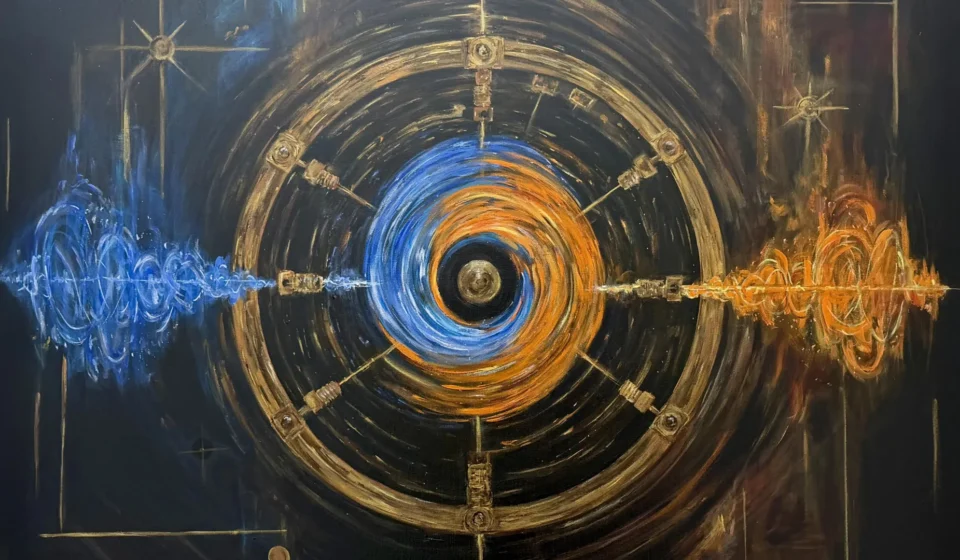
The team focused on the concept of "synthetic rotation." Instead of spinning a physical object, they proposed to manipulate the properties of a medium across both space and time. By rapidly switching the electrical properties of a circuit in a precisely synchronized pattern, they could create a traveling wave front that "appears" to rotate to any electromagnetic signal passing through it.
Phase 2: Building the Metamaterial
Between 2021 and 2023, the team developed a specialized ring of electronic resonators. These were not merely wires; they were engineered metamaterials designed to modulate electromagnetic waves with high precision. By sequentially modulating the impedance of these resonators, the team generated a rotating pattern of electromagnetic potential.
Phase 3: Empirical Validation
In the final phase of the study, the researchers introduced radio frequency waves to the ring. They observed that waves with specific rotational characteristics did not merely pass through the device. Instead, they gained energy, emerging from the system with higher intensity than they entered. This was the first empirical confirmation of the Penrose-Zel’dovich effect in a laboratory setting, effectively proving that synthetic rotation can replicate the gravitational physics of black holes.
Supporting Data: The Mechanics of Synthetic Motion
The core of the experiment relies on a breakthrough in metamaterial engineering. Conventional mechanical systems are limited by structural integrity; as an object spins faster, the centrifugal forces eventually cause it to disintegrate. Furthermore, traditional rotational speeds are infinitesimally slow compared to the speeds required to observe black hole physics.
The CUNY ASRC device overcomes this by utilizing "time-modulated" systems. In these systems, the properties of the material—such as capacitance or inductance—are altered at frequencies that mimic the velocity of a spinning object. The "synthetic" speed achieved by the researchers far exceeds the physical limitations of any solid material.
- Rotational Illusion: By adjusting the modulation sequence of the resonators, the team created a "rotational velocity" that could be dialed to specific values, allowing for the fine-tuning of energy extraction.
- Broadband Amplification: The experiment demonstrated that this process is not limited to a single frequency. It allows for broadband, selective amplification, meaning the researchers can target specific wavelengths for energy transfer.
- Stationary Dynamics: Because the system is entirely electronic and stationary, it allows for high-fidelity measurements that would be impossible to capture in a turbulent, high-velocity mechanical experiment.
Official Responses and Expert Commentary
The research team emphasized that this experiment is more than a validation of old theories; it is the creation of a new, versatile tool for physics.
"Our approach facilitates a new method of wave-matter interaction in which waves with selected rotational properties extract energy from synthetic time-engineered rotation, producing a form of broadband selective amplification," explained Andrea Alù, principal investigator and founding director of the CUNY ASRC’s Photonics Initiative. "We are effectively taking the most extreme physics of the universe and shrinking it down to a laboratory tabletop."
Lead author Hadiseh Nasari added that the transition from theory to practice was the most significant milestone. "This successful experiment moves ideas about extreme rotational dynamics from theory to practice and creates a versatile experimental platform for exploring a broad range of phenomena at the intersection of astrophysics, wave physics, and quantum science," she noted.
Hady Moussa, co-lead author and former PhD student, highlighted the role of metamaterials in the success of the study. "Waves with the appropriate rotational characteristics extracted energy from the system and became amplified, reproducing the essential physics of the Penrose-Zel’dovich process. Our approach relies on engineered metamaterials that are designed to control how waves propagate in ways that were previously thought impossible."
Broader Implications for Science and Technology
While the experiment provides a window into the behavior of black holes, the implications extend far beyond astrophysics. The ability to manipulate wave-matter interactions through synthetic rotation has several immediate and long-term applications:
1. Wireless Communications and Photonics
The amplification technique developed by the team could lead to more efficient methods of signal processing. By using synthetic rotation, engineers could develop new types of amplifiers that are more compact and energy-efficient than current technologies, potentially revolutionizing the speed and range of 6G networks and beyond.
2. Quantum Information Science
The experiment suggests that these principles can be extended into the quantum regime. If light and matter can be coupled via synthetic rotation to amplify energy, this could be harnessed to create new types of quantum transducers—devices that convert signals between different quantum systems, which are essential for building a functional quantum internet.
3. Studying Extreme Environments
With a stable, controllable laboratory platform, researchers can now simulate regimes of extreme physics that would otherwise require travel to the center of a galaxy. This provides a "sandbox" for testing how matter behaves under intense, non-linear conditions, which could lead to a deeper understanding of dark matter, gravitational waves, and the very nature of spacetime.
4. Future Challenges
Despite the success, the team is cautious about immediate commercialization. Significant work remains to scale the technology for practical devices. Current experiments are limited to the radio frequency spectrum; moving these principles into the optical range, where photonic technologies operate, will require further breakthroughs in nanostructuring and ultra-fast material science.
Conclusion
The CUNY ASRC study represents a rare instance where the abstract musings of 20th-century theoretical physicists have been brought to life through 21st-century material engineering. By proving that one does not need a black hole to harness the physics of one, the researchers have effectively opened a new door in the scientific landscape. Whether through the development of next-generation communication devices or by providing a deeper understanding of the fundamental forces that govern our universe, the ability to synthesize rotation is poised to become a transformative tool in the pursuit of scientific discovery. The era of "tabletop astrophysics" has officially begun.