


Powering the Future: How Zonal Architecture and 48V Systems Are Rewiring the Automotive Industry

By Monolithic Power Systems, Inc. (MPS) | July 20, 2026
The global automotive landscape is undergoing a structural metamorphosis not seen since the assembly line. As vehicles evolve from simple mechanical transport into complex, software-defined mobility hubs, the underlying electrical infrastructure—the nervous system of the car—has reached its breaking point. For seven decades, the 12V electrical architecture has served as the industry standard. However, the surge in demand for autonomous driving, high-performance infotainment, advanced driver-assistance systems (ADAS), and creature comforts like heated seating and sophisticated cabin lighting has rendered the legacy 12V system increasingly insufficient.
To meet the power demands of the next generation of vehicles, the industry is converging on two transformative solutions: the shift from traditional domain-based architectures to zonal architectures, and the migration to a 48V power distribution system.

The Main Facts: The End of the 12V Era
The core challenge facing modern automotive engineering is "power density." As cars integrate more high-speed sensors, LIDAR units, and high-performance computing clusters, the current required to operate these systems is skyrocketing. According to Ohm’s Law, power is the product of voltage and current ($P=VI$). Maintaining a 12V system while increasing power necessitates a proportional increase in current, which leads to thicker, heavier wiring harnesses. In modern luxury vehicles, these harnesses can weigh as much as 50 kilograms, negatively impacting fuel efficiency and, more importantly, range in battery electric vehicles (BEVs).
By moving to a 48V architecture, engineers can deliver four times the power while keeping current levels manageable. This reduction in current allows for thinner wiring, leading to significant weight savings and improved packaging efficiency. However, a 48V transition is not merely a "plug-and-play" upgrade; it requires a fundamental rethinking of how data and power are routed across the vehicle. This is where zonal architecture becomes the essential enabler.
Chronology of the Architectural Evolution
The history of vehicle electronics can be categorized into three distinct eras:

- The Distributed Era (1950s–2000s): During this period, vehicles used discrete Electronic Control Units (ECUs) for individual functions. If you wanted power windows, you added a module. If you wanted a radio, you added another. This led to "spaghetti" wiring as the number of features grew.
- The Domain Era (2010s–Early 2020s): Automakers realized that distributed systems were inefficient. They began grouping ECUs into functional "domains," such as powertrain, infotainment, and chassis. While this reduced complexity, it still relied on heavy wiring harnesses connecting disparate sensors to centralized domain controllers.
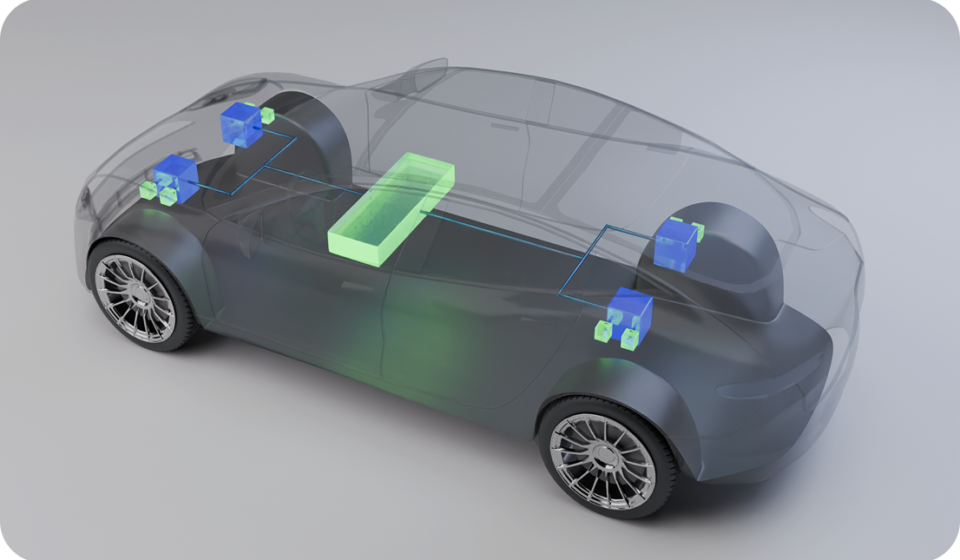
- The Zonal Era (2025–Present): The current shift focuses on physical location rather than functionality. In a zonal architecture, a vehicle is divided into physical zones (e.g., front-left, front-right, rear-left, rear-right). Zonal gateways act as high-speed connection points that handle power distribution and data communication for all devices within their vicinity. This minimizes wiring length, reduces latency, and allows for centralized computing to manage the entire vehicle’s intelligence.
Supporting Data: Why Zonal Architecture Wins
The transition to zonal architecture provides quantifiable advantages in manufacturing, safety, and reliability.
- Wiring Harness Optimization: By moving to a zonal configuration, manufacturers have reported up to a 30% reduction in the length and weight of wiring harnesses. This reduction directly translates to a lower bill-of-materials (BOM) cost and easier assembly for robotic manufacturing.
- Deterministic Latency: In a domain architecture, signals often travel across the entire vehicle to reach a central processor. In a zonal setup, local zones process data close to the source, ensuring that safety-critical functions—such as braking or steering commands—benefit from lower, more predictable communication delays.
- Thermal Efficiency: The shift to 48V reduces $I^2R$ (resistive) losses. By operating at higher voltage, the power distribution network becomes inherently more efficient, generating less waste heat and allowing for smaller, more reliable power management components.
Official Perspective: The Role of Silicon Innovation
The transition to a 48V/zonal future is not possible without significant advancements in power management integrated circuits (PMICs) and intelligent switching solutions. Monolithic Power Systems (MPS) has been at the forefront of this evolution, developing technologies specifically designed for the high-density, high-reliability requirements of modern vehicle zones.
"We have been working on providing solutions to the automotive industry’s biggest challenges for years, long before those challenges were fully recognized by the major players," stated a representative from the MPS engineering team.

A prime example of this foresight is the MPQ5884-AEC1. This 80V e-fuse is designed to serve as a critical component in a zonal architecture. By providing high current density in an ultra-compact package, it allows for the integration of smart high-side power switching directly into the zones. Unlike traditional fuses, which are non-reversible, the MPQ5884-AEC1 provides advanced diagnostics, monitoring, and rapid response, ensuring that if a fault occurs in one zone, it does not cascade into a system-wide failure.
Implications for the Future of Mobility
The shift to a 48V zonal architecture is more than an engineering preference; it is a prerequisite for the future of the autonomous and electrified vehicle.
1. Enabling Autonomy
Autonomous vehicles rely on a constant, high-speed flow of sensor data. Zonal architecture provides the reliable, high-bandwidth backbone required for these systems to communicate without the risk of wire-harness degradation or signal interference.

2. Streamlined Manufacturing
As automakers push for shorter development cycles, the modular nature of zonal architecture is a game-changer. By using standardized zonal controllers, manufacturers can scale vehicle features across different models with minimal redesign of the power distribution network.
3. Safety and Reliability
Modern vehicle safety is increasingly tied to software. Zonal architecture supports redundancy; if one zone experiences a power disruption, the centralized compute unit can reroute power and data to ensure the vehicle remains in a "safe state."
4. Sustainability
Lighter vehicles require less energy to move. The weight savings achieved through optimized 48V wiring harnesses contribute directly to the extended range of electric vehicles, addressing one of the primary hurdles to mass adoption.

Partnering for the Transition
As the industry pivots toward this 48V, zonal future, the role of the semiconductor partner has changed. It is no longer enough to supply components; companies must provide system-level expertise. MPS, through its deep relationships with Tier 1 suppliers and major automotive OEMs, is positioning itself as an advisor in this transition.
From early-stage design consultations to providing evaluation boards and priority engineering support, the goal is to reduce the barrier to entry for zonal architecture. For engineers and designers, the move to a 48V ecosystem is a daunting challenge, but it is one that offers the potential for unprecedented vehicle performance and reliability.
For those ready to begin the transition, resources are available to help navigate the technical complexities. Interested parties can gain early access to product datasheets and technical documentation by signing up for myMPS+, or by reaching out directly to the MPS technical support team.

As we look toward the remainder of the decade, it is clear that the 48V zonal architecture will be the bedrock of the next automotive revolution. The vehicles of 2030 will be safer, smarter, and more efficient, thanks to the quiet, complex, and vital work being done today in the realm of power management.
Keywords: #Electrification #ZonalArchitectures #AutomotiveEngineering #48VSystems #MonolithicPowerSystems