
Bridging the Labor Gap: Monumental Secures $32M to Bring Autonomous Bricklaying to the American Horizon

In an era where the global construction industry is grappling with a dual crisis—a staggering shortage of skilled labor and an escalating demand for affordable housing—technology is increasingly seen not just as an auxiliary tool, but as a fundamental necessity. Monumental, the Amsterdam-based robotics innovator, has emerged at the forefront of this shift. This week, the company announced a successful $32 million Series B funding round, a milestone intended to propel its autonomous bricklaying technology across the Atlantic and into the United States market.
Led by Khosla Ventures, with participation from Hummingbird, Plural, and other prominent investors, the funding marks a pivot from experimental research and development to large-scale commercial deployment. As Monumental prepares to scale its operations, the move signals a broader transformation in how the world’s most basic infrastructure—the brick wall—is conceived and constructed.
Main Facts: A New Blueprint for Construction Robotics
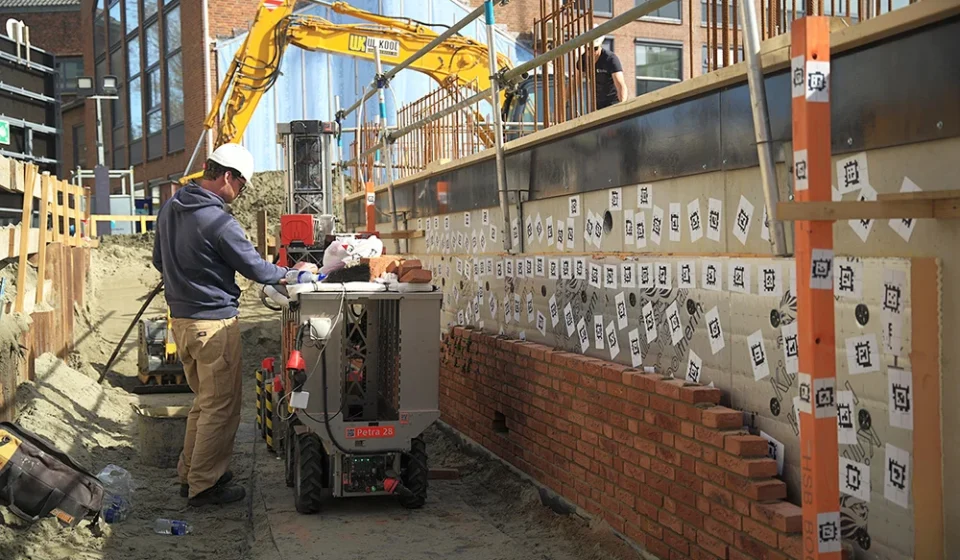
The core of Monumental’s value proposition lies in its unique fusion of hardware and software. Unlike traditional industrial robots that operate in the highly controlled environments of factory floors, Monumental’s robots are designed for the "chaos" of the active construction site. These electric, autonomous units utilize a sophisticated suite of sensors, computer vision, and the company’s proprietary AI software, Atrium, to navigate uneven terrain and lay bricks with a level of precision that rivals or exceeds human capability.
Key highlights of the announcement include:
- Funding Scale: $32 million in Series B financing to fuel U.S. expansion and R&D.
- Business Model: Monumental operates as a subcontractor, charging for finished masonry rather than selling or leasing the robots.
- Operational Success: The company has already completed masonry for over 100 homes, schools, and hotels across the Netherlands and the United Kingdom.
- Strategic Expansion: Plans to establish a U.S. presence in 2024 to address the chronic shortage of hundreds of thousands of construction workers.
By positioning itself as a subcontractor, Monumental removes the "tech anxiety" often associated with high-end robotics. Contractors do not need to learn how to program a robot or worry about maintenance; they simply hire Monumental to deliver a finished wall, integrating the technology seamlessly into existing supply chains.
Chronology: From R&D to Real-World Provenance
The journey of Monumental has been defined by a disciplined progression from laboratory concepts to muddy construction sites.
The Foundational Phase (Series A)
The initial years of Monumental were dedicated to solving the "outdoor problem." While robots have thrived in automotive plants for decades, the outdoors presents variables—changing light, wind, rain, and uneven ground—that typically baffle standard sensors. During the Series A phase, the engineering team focused on building a robust hardware stack and the early iterations of the Atrium AI. The goal was to prove that a mobile robot could pick up a brick, apply mortar, and place it accurately according to a digital blueprint.
The Proof of Concept (2022–2023)
With the technology stabilized, Monumental moved into the "Real-world R&D" phase. This involved deploying units on active sites across Europe. This period was crucial for identifying what CEO Salar al Khafaji calls the "unknown unknowns." These are the unwritten rules of construction—how to coordinate with a plumber who needs to run a pipe through a wall or how to adjust when a foundation is slightly off-level. During this time, the company successfully completed walls for more than 100 homes, as well as complex structures like canal walls and hotels.
The Scaling Phase (2024 and Beyond)
The current Series B funding represents the third chapter. Having proven that the robots can work alongside human crews without causing delays, Monumental is now focusing on scale. This includes increasing the size of their fleet, expanding the repertoire of tasks (moving into tiling or wall-tie insertion), and entering the massive, albeit fragmented, U.S. market.
Supporting Data: The Economic and Labor Drivers
The push into the United States is backed by sobering statistics. The U.S. construction industry is currently facing a labor deficit that fluctuates between 200,000 and 400,000 workers in any given month. Furthermore, industry analysts suggest that to meet the soaring demand for residential housing, the U.S. will need to recruit approximately 2.2 million new workers over the next three years.
The Labor Deficit
As the older generation of skilled masons retires, younger workers are not entering the trades at a replacement rate. This "silver tsunami" has led to increased labor costs and project delays. Monumental’s robots are designed to fill this specific void. By automating the repetitive, physically taxing aspects of bricklaying, the company allows the remaining human workforce to focus on more complex tasks such as site management, intricate detailing, and overall project coordination.
Precision and Efficiency
In traditional masonry, human error can lead to material waste and structural inconsistencies. Monumental’s robots achieve "millimeter precision." This level of accuracy ensures that digital building plans are followed to the letter, reducing the need for costly rework. Additionally, because the robots are electric, they offer a quieter and more sustainable alternative to heavy diesel-powered machinery, aligning with modern "Green Building" initiatives.

Official Responses: Insights from Leadership
Salar al Khafaji, co-founder and CEO of Monumental, emphasizes that the company’s mission is about partnership rather than replacement.
"The funding will help to grow our world-class team of hardware and software engineers, launch the company in the U.S. this year, scale the number of robots it can deploy across Europe, and expand the range of construction tasks the robots can handle beyond bricklaying," al Khafaji told The Robot Report.
Addressing the concerns of labor replacement, al Khafaji is clear: "Our goal isn’t to replace people, but to give the industry the additional capacity it desperately needs. By taking on repetitive bricklaying work, the robots allow skilled workers to focus on higher-value tasks while helping the industry build more homes and infrastructure despite persistent labor shortages."
The CEO also highlighted the importance of the company’s "boots on the ground" experience. "The biggest lesson that we learned is that this actually works. Our Series A round was focused on R&D and proving small-scale success. Our Series B was raised off of real-world success. Real construction sites are the best R&D lab."
Investors share this optimism. Vinod Khosla, founder of Khosla Ventures, has a long history of backing "moonshot" technologies that solve fundamental societal problems. By leading this round, Khosla Ventures is betting that the automation of the physical world is the next great frontier for AI.
Implications: A Paradigm Shift in the Built Environment
The expansion of Monumental into the U.S. market carries significant implications for the future of construction, urban planning, and the labor market.
1. Housing Affordability
One of the primary drivers of the housing crisis is the cost of construction. If robotics can reduce the time and labor cost associated with building the "shell" of a home, those savings could—in theory—be passed down to the consumer. While masonry is only one part of a build, the precedent set by Monumental could encourage the automation of other trades, such as roofing, drywalling, and painting, leading to a more streamlined and affordable construction cycle.
2. Workplace Safety and Ergonomics
Masonry is grueling work. It involves lifting thousands of pounds of material daily and working in awkward positions that lead to long-term musculoskeletal injuries. By offloading these "dull, dirty, and dangerous" tasks to robots, the construction site becomes a safer environment. Human operators transition from manual laborers to "robot supervisors," a role that is physically easier and requires a different, more tech-centric skill set.
3. The "Atrium" Ecosystem
The Atrium AI platform represents a shift toward the "Digital Twin" concept in construction. Because the robots work directly from digital plans, every brick laid is recorded in a digital database. This creates a highly accurate record of the building’s structural integrity, which can be invaluable for future maintenance, renovations, or insurance assessments.
4. Navigating the Fragmented U.S. Market
The U.S. market presents a unique challenge: building codes and labor regulations vary significantly from California to Texas to New York. Monumental’s software-first approach allows for rapid adaptation. Unlike a "hard-wired" machine, Monumental’s robots can be updated via software to comply with local masonry standards or specific regional building techniques.
Conclusion
The $32 million Series B round for Monumental is more than just a financial injection; it is a vote of confidence in the viability of autonomous construction. As the company prepares to deploy its fleet across American soil, the construction industry stands at a crossroads. The transition to robotic assistance is no longer a futuristic dream but a present-day reality, driven by the cold math of labor shortages and the urgent need for housing.
By proving that robots can thrive in the unpredictable environment of a building site, Monumental is laying more than just bricks; it is laying the foundation for a more efficient, safe, and productive construction industry for the 21st century. As al Khafaji noted, the "unwritten unknowns" of the real world are the ultimate test, and Monumental appears ready to pass that test on a global scale.